
EDITORS NOTE: In Part-2 of Wally’s tribute to the Daytona he recounts some other lesser known facts about one of his favorite Ferrari’s. See Also Part-1
The Ferrari 365 GTB/4 Daytona is one of the great Ferraris of the ‘70s, which is ironic considering that, during its development, the concept of a front-engine GT car continuing to be a contender for top dog was up for debate. Even prior to launch, the successor to the 275 GTB was, in some ways, a placeholder until the mid-engine 365 GT4BB would come along. Why? Because that damned Ferrucio Lamborghini, a farm tractor builder, had introduced the mid-engine Lamborghini Miura in 1965 (after being insulted personally by Enzo Ferrari and told to “go back to tractors.” His totally wild concept turned the performance car world on its head.
It was doubly embarrassing for Ferrari, because he had been fielding mid-engine race cars for years, and obviously believed that, for the track, mid-engine was the way to go, but he never figured the public would want a car so bereft of luggage room and with the attendant cooling problems.
Now Enzo Ferrari did in fact have a mid-engine production car in the works, the 365 GT4BB (Berlinetta Boxer), but it was still a long way off from completion. Meanwhile, the 275 GTB was getting old, so Ferrari needed to fill the void until the Boxer would be ready. The solution? To have Pininfarina design a new-looking car that was based on the 275 GTB.
Ironically the plans didn’t quite gel as he envisioned. The Boxer took so long to get sorted out that , by the time it was ready, U.S. importation rules changed to the point where altering a Euro.-spec car to make one that would comply with American regulations was deemed a lost cause. So Enzo passed on selling the BB in America, and instead continued to push the Daytona. In the U.S. at least, the “placeholder” became a winner.
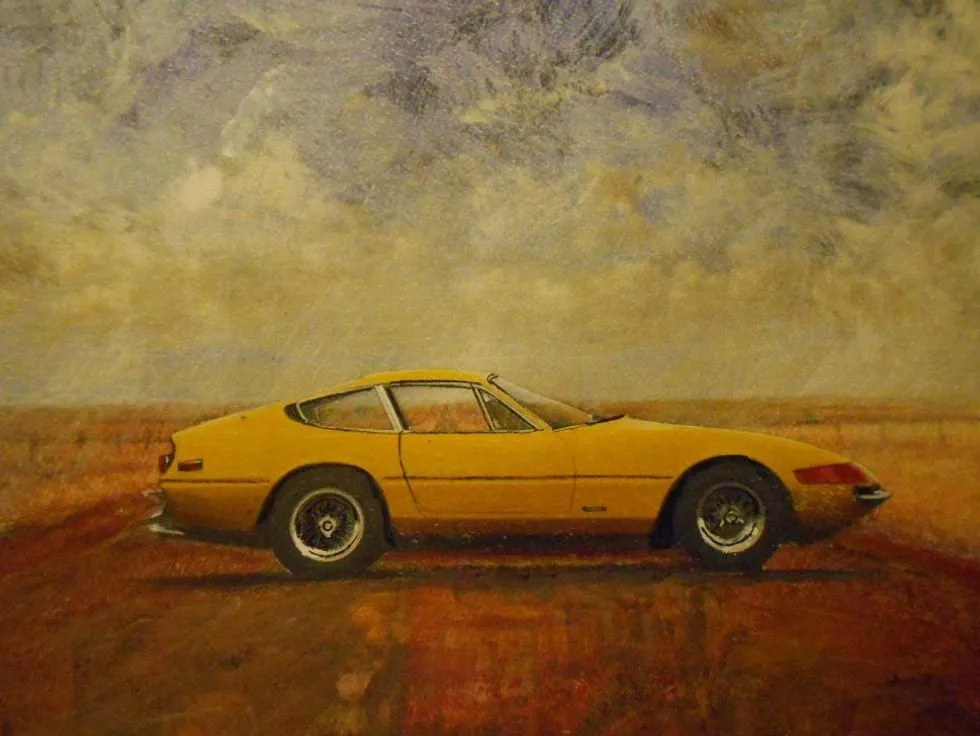
It is easy to see that the Daytona is an updated 275GTB/4. If you squint at the side views of it compared to the 275 GTB, it was really just a sharpening up of the lines of that earlier car, with the addition of rear 3/4 windows. The Daytona has a larger 4.4-liter V-12 engine than the 275, and all of them came with six Weber twin-choke 40 mm carburetors ( some of the 275 GTBs had three carburetors). Thanks to a rear-mounted transaxle gearbox, the Daytona boasted good weight distribution, too.
The Daytona’s big styling departure was hidden headlamps. The originals (now nicknamed “Euro” models) had the headlamps fixed in place and showing through clear plastic, but those didn’t meet US standards, so when Ferrari up-dated it to meet American laws, we got the pop-up lights with sealed-beam bulbs.
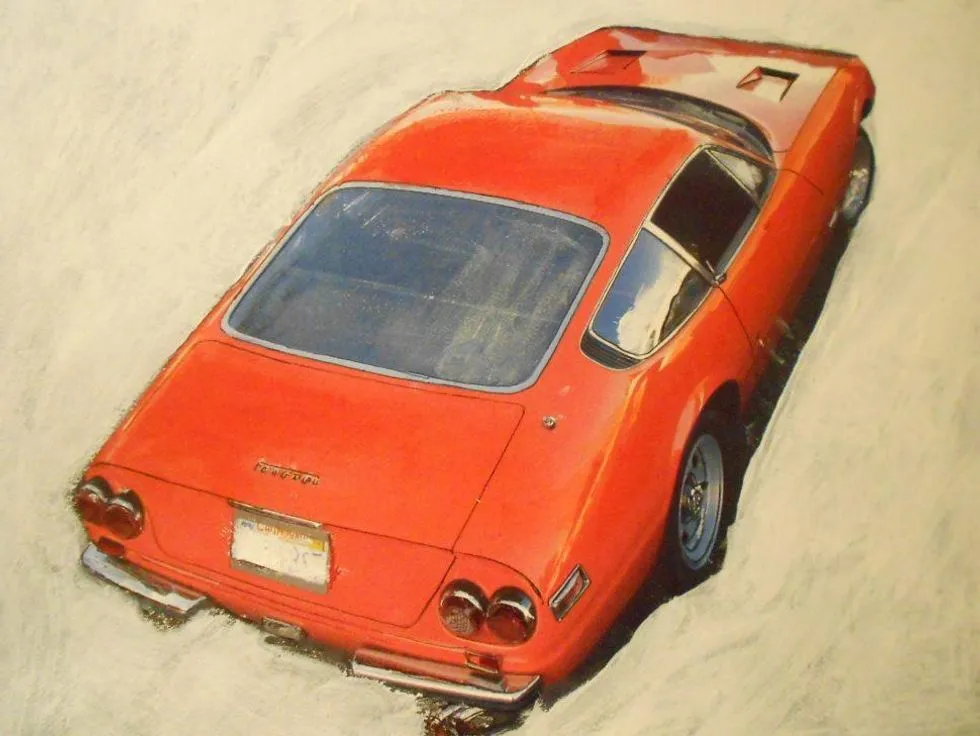
The typical lines of the Daytona were maybe even better-looking when painted in red.
As per Ferrari practice, the new model was rolled out first at the Paris Salon, this one in the autumn of 1968. Though it did not say “Daytona” in script anywhere on the car, the nickname quickly stuck, supposedly in recognition of the Ferrari 1-2-3 sweep in the Daytona 24-Hour Race in 1967, a real slap in the face of Ford who, after having won LeMans in ’66, once again had that Ferrari horse kicking dirt in their face.
Many Ferrari fans look back on the Daytona with no small amount of nostalgia, because it was the last new 12-cylinder Ferrari model announced before Fiat swept in–purchasing 40-percent of Ferrari’s stock with the provision that the remaining available shares would be bought upon Enzo Ferrari’s death. They took over production of road cars in 1969. It was also the last V-12 Ferrari to be sold new in the USA (through official channels) until 1992. Of course the Boxer was a 12 cylinder, but a flat-12;and they crept in only as a gray market import. (As an aside, the Berlinetta Boxer was technically not actually a boxer engine because it paired pistons on a common crank journal. The BB initials were actually a tribute to Brigitte Bardot.)
Ferrari worried so much that Americans would feel “cheated” that they didn’t get the full width Plexiglass strip between the headlights on the European Daytona model that they added a silver band across the front, sort of simulating the Euro model’s strip, but finally just gave up on that look and made that portion body color.
Like the Dino and other Pininfarina-designed Ferraris, the Daytona had a chopped “Kamm” effect tail, and twin round taillamps. The body was still built the old fashioned way by Scaglietti,(pronounced Scal-yetti) most of them in steel with aluminum doors, bonnet, and boot lid, although, later in the production run, the doors were changed to steel, and bracing struts added to suit U.S. laws. The cabin was a five-window design with a large lightly curved windscreen, and an almost flat rear screen bounded by sail panels (with inset rear ¾ windows) that ran in a continuous line into the tail panel.
Along Came a Spyder
As is usual with Ferrari, the open car came later, in the model run, the 365 GTS/4 premiering at the 1969 Frankfurt Show. It kept most of the body style from the waist down. There was also a one-off Targa made with a brushed aluminum covered roof rollover bar similar to the Porsche targa and a plastic flexible rear window. Your author saw that in the US so there’s a chance it’s still out there on these shores, an exceedingly valuable unico examplare.
The Spyder had a double spike in popularity because In October 1975, the Daytona Spider was acquired by Warner Bros. Pictures through dealer Grand Touring Cars. and appeared in two films released in 1976: A Star Is Born and The Gumball Rally. Both productions featured a red Daytona Spider. And of course in 1984, a Ferrari Daytona Spyder, was driven by Sonny Crockett during Seasons 1 and 2, as well as the first episode of Season 3. However, purist that I am, I shouldn’t celebrate that because the Daytona used on the TV series was not a real Ferrari. so the production used several replicas built on the chassis of a Chevrolet Corvette C3 by car designer Tom McBurnie.
The Spyder was so popular it took 10 per cent of Daytona model sales. In fact, Ferrari couldn’t meet demand and “conversion” shops–like that of Richard Straman in Costa Mesa, California–sprung up all over the U.S., creating dozens of Spyders out of coupes. Today a converted Spyder is worth a lot less than one made by the factory. If only Straman and others had saved the cut off roof so they could go back to a coupe!
The running gear
The Daytona’s engine was derived from the 275 GTB/4 V-12, but with a larger, 4390cc capacity from a bore and stroke of 81mm x 71mm. Every one of them used dry sump lubrication. It was fitted with a bank of six twin-choke Weber 40 DCN20 or 21 carburetors, to produce a claimed 352 hp. Because the US market had so many emissions requirements, the Daytona was burdened with a fast idle device and an exhaust manifold air injection system. It still had a great sound, however.
The engine drove through a flywheel-mounted clutch, via a shaft running at engine speed in a torque tube, mated to a five-speed transaxle mounted almost identically to that of the 275 GTB4. The suspension was wishbones, coil springs and hydraulic shock absorbers at each wheel.
Even the regular Daytona could do 174 mph, but Ferrari anticipated no demands for a Comp version. It was only after his dealers started to make their own conversions that Ferrari reluctantly began to make race versions. From the factory there were three series of comp cars, each consisting of five client competition cars built at the factory’s “Assistenza Clienti” department in Modena. Earlier, a one-off all-aluminum bodied car was built for Luigi Chinetti’s North American Racing Team.
The first series of five full comp cars, built in 1971, had all aluminum bodies. They featured slightly flared wheel arches with wider wheels, aerodynamic “fences” on the front wings, a small chin spoiler, and no quarter bumpers.
The second series, produced in early 1972, had steel bodies with the aluminum bonnet, boot lid, and doors of the road cars, but with much larger flares to the wheel arches, to accommodate even wider wheels and tires. A third series, made in early 1973, showed continued cost cutting, with steel doors, and only the bonnet and boot lid in aluminum.
The competition cars were successful in GT racing. At the Le Mans 24-Hour Race in 1972 they finished in the top five positions in their class, repeating the class wins there in 1973 and 1974. As late as 1979, they were still performing well, even taking a second overall in the Daytona 24-Hour Race, amazing when you consider the car was now an old used model that had been out of production for six years. Take that, mid-engine cars!
Driving a Daytona
I only drove a Daytona a couple of times. The first was when a young heir went out and dumped his inheritance on a Daytona for about $19,000 in the early ‘70s and let me drive it on a deserted road. I got up to 140 mph, impressed by the brutal acceleration and the sound as all six carbs opened both throats as it passed 7500 rpm. The heir proceeded to drive the Ferrari like a hellion for months until he was talked out of it by a slick talking car dealer who traded him five cars of dubious value for it. (He probably cringes every time he sees a Daytona….)
I was impressed by the speed, and the roar of the engine, but didn’t care for the fact you had to wait for the car to get warm or else you’d damage the gearbox. And the steering was very stiff, with no power assist. A race driver who competed with the NART sponsored one at Daytona told me it was so hard to steer at 170 moh that, by the end of the race, his hands were bleeding! So it was a brute to drive around town. Maybe you could compare it to strolling down the street with a “tame” grizzly bear on a leash.
The second time I drove one was when I was thinking of buying one for $43,000, but the gears had already been damaged by the owner taking off too many times ignoring the cold gearbox problem. Who knows what a rebuild would’ve been back then, in the early ‘80s? The last time I looked, even the average Daytona was selling for ten times that long-ago price.
Where have all the Daytonas gone?
The Daytonas have a certain amount of classic styling grace that has kept them looking modern all these years. I have to say that, looking back from 2026, the only flaw I can find as a design critic, is that the taillights now seem too small by about 25 percent.
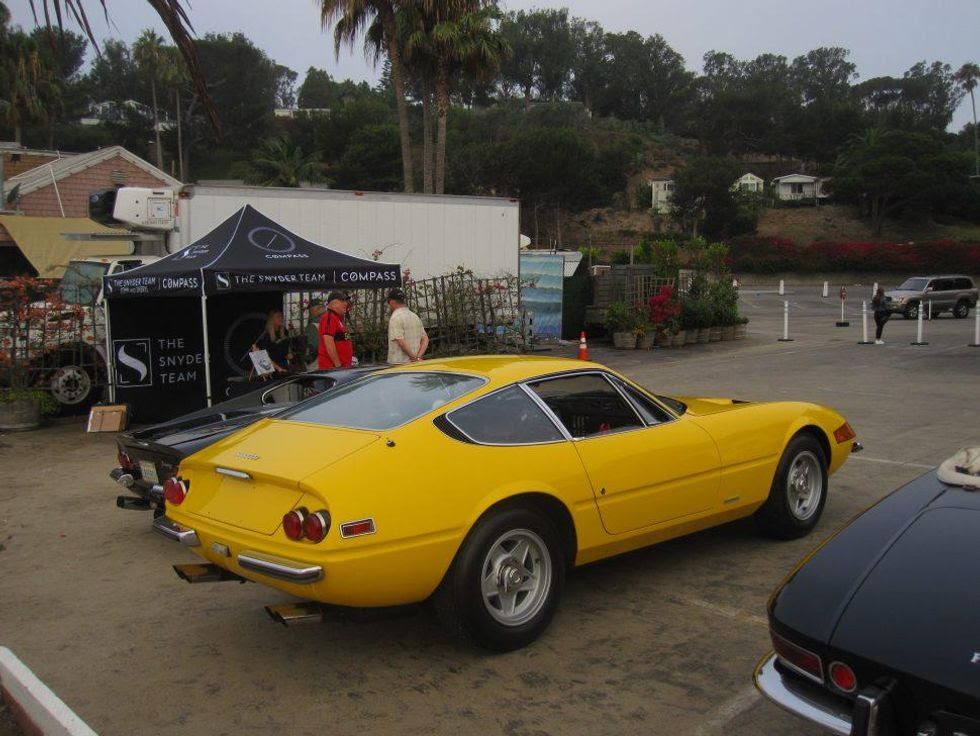
But Daytonas are continuing to climb in value. Ferrari puts the numbers made at: Coupes 1968-’73 1,284 Spyders GTS/4: 122.
Those possessing a documented racing history, are leading the value parade, with spiders next, and those with celebrity rub-off (or starring in films) having their fans as well. I have been to several car events lately and Daytonas are few and far between. I can only conclude that they’ve been forgotten, are being restored, or are considered too valuable to just drive on the street, and are being saved for concours events.
It’s a shame Daytonas don’t come out more. They were one of the last Ferrari road cars whose engineering, design and production was supervised by The Man himself, Enzo. That makes the Daytona more related to Ferrari’s original intentions than the cars originated after Enzo’s death. With that in mind, I can forgive some of the flaws, and, if you only drive it once a week, even those flaws aren’t something you have to live with daily.

ABOUT THE AUTHOR/ARTIST: Wallace Wyss (rhymes with "Reese"), the author of 18 automotive books - now a fine artist - depicts postwar sports cars in oil on canvas. Wearing his artist hat, Wallace Wyss says, if art galleries, exotic car stores and car museums want to talk the possibility of taking art on consignment, he can be reached at photojournalistpro2@gmail.com