
Some race cars have resumes that show high points and low points, and for this particular car, the low point was a later death for its celebrity owner, who I had met when working at MotorTrend and seeing a racing Ferrari on Sunset strip six floors below. I ran lickety-split down the stairs and flagged the driver to the curb and offered him a chance to be in MotorTrend even though Sports Car Graphic was the house sports car publication.
The 412 might be classed as the ”street version” of the wild P3/4 that had done so well in racing, restoring Ferrari’s reputation after Ford beat them in LeMans in ’66.
For 1967, Ferrari built two 412 Ps and for good measure, also converted a pair of ex-works P3s to 412 P specification. (which they knew would appeal to street drivers as what could be greater status if, on the street, anybody asked the owner if the car eve raced and you could say “Well, Le Mans…”
The four 412s went to North American Racing Team (NART), Scuderia Filipinetti, Maranello Concessionaires and Ecurie Francorchamps (the US, Swiss, British and Belgian Ferrari importer teams).
Their role was to back up the factory -entered 330 P4s at the 1967 World Sportscar Championship events.
This yellow car, 0850 , was one of the two brand new 412 Ps (though originally painted red, it was repainted for Jacques Swaters, the Belgian Ferrari agent whose team, Ecurie Francorchamps, ran cars in yellow, the Belgian national racing color.
The car was entered in the Daytona 24 Hours, the Spa 1000km and Le Mans 24 Hours in 1967.
At Daytona, it was driven by Willy Mairesse and Jean Blaton. They qualified eleventh and by the second hour (after Ford’s falling out) had climbed to second.
Mairesse and Blaton held strong but fell behind the works P4s early Sunday morning. They went out at 3am with gearbox problems.
The yellow race car’s next outing came in the 1000km race at Spa twelve weeks later. Mairesse and Blaton were once again at the wheel and qualified fourth. This time it was rain, rain , rain but by the 10th lap, Mairesse in the Ferrari was close b behind Jacky Ickx in a Mirage M1), both cars a good ten seconds lead on all the rest. .
When Blaton pitted to hand the wheel back to Mairesse 0850 was still second, albeit now with a bigger gap.
But a fast right-hander caught Mairesse unawares, and he went off the track, wreck the car and walked away with only minor injuries.
Ferrari took 0850 back to the factory for a rebuild, but there was no time to compete at Le Mans.
Ecurie Francorchamps still made the event, renting another P4 Scuderia Ferrari (0856) and they finished third with stints by Mairesse and Blaton.
The wrecked car, now rebuilt, went to Francorchamps in time for the last major European race of 1967; the Paris 1000km at Montlhery.
A non-championship event, Blaton was this time co-driven by Lucien Bianchi and 0850 qualified fourth.
Again rain, but Bianchi rose to third by the end of the first lap. He dropped to tenth on lap eight when he lost time in the pits having oil wiped out the windscreen), but had worked his way back up to fifth in 20 laps.
Bianchi and Blaton subsequently climbed through the field to finish second, one lap behind the winning Mirage M1 of Jacky Ickx and Paul Hawkins.
Jean Blaton purchased 0850 at the end of the year along with an ex-Francorchamps Dino 206 S (010). He also acquired a new Ford GT40 (chassis 1079) which would be his main car for 1968. (Talk about switching sides—Ford had been Ferrari’s “enemy team” in ’66!
But then there was a rules change and no place to run the car, as now Group 6 prototypes could be only three liters.
Larger engined cars could still run, in Group 4, but 50 cars had to be made were required for homologation and Ferrari was not about to make 49 more of “last year’s car.”.
Blaton , an experienced Hillclimb racer, went back to his old haunts, and drove the 412 P (along with his Dino) in the 1968 Belgian Hillclimb Championship. Two wins and two second places were recorded in the 412.
ENTER THE MOVIE STAR
Now we get to where yours truly, early in the ‘70s, spotted the actual car in traffic more than 100 ft. straight down from his office on Sunset Strip.
In mid 1968, Blaton had sold 0850 to a young singer and actor, 18 year old Dean Martin Jr. (the son of entertainer, Dean Martin).
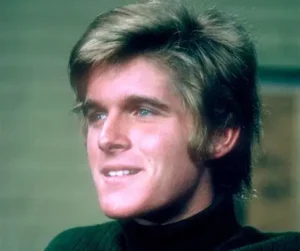
Martin Jr. had already owned several sports cars, including at some point, a DeTomaso Vallelunga and Mangusta, but wanted the ultimate car to drive on the street—a Ferrari prototype no less! He hired a Los Angeles race car specialist, Lee Martin, and bought the car in Europe, with the engine rebuilt before the car arrived from Europe.
Then came trouble. In moving the car by forklift (not, I might add, the best way to move a race car) the car fell off the truck and damaged the front end so much that it went to Lee Martin’s shop, Precision Auto Body, for repair and full conversion for street use. Altogether, the car, the crash and rebuilt cost around $30,000, big money for those days.
The conversion involved a lot of little things to make it more roadable, like slightly raising the ride height, adding a pair of extra cooling fans for the radiator, roof-mounted mirrors, different plugs, re-jetted carburetors and a modified exhaust that exited through the tail.
Race cars are hot inside, so the coolant pipes and oil pipes were re-routed from through the chassis to underneath the car.
New engine shrouding was installed to keep hot air away from cabin and the front brake ducts were reconfigured to become passenger cooling ducts.
Discrete engine cooling scoops were mounted behind the side windows.
During the body repairs, all exterior rivets were removed. The body was then welded in place for a smoother look instead of just being attached.
Martin wanted to be sure to be seen in his race car so he had a P4-style Spider roof added and THE windscreen reinforced to help support its weight.
A rudimentary fiberglass hardtop was also manufactured. (Yes, it does rain in California!)
The seats were reupholstered in fresh vinyl and carpet was fitted for the first time.
THE SIGHTING
Now back to my sighting: after I saw the car and got the owner info, unfortunately my nemesis, the magazine’s ace photographer, got the job of shooting it. Let’s face it, he was a better photographer.
I met Dino one more time when he was in a shop getting a quote on re-doing a Mangusta, a car so mechanically interior to the 412 they aren’t even on the same planet.
He sold the 412P , and didn’t keep it as his greatest find, as we all tell ourselves we would if we found it.
Martin met a sad end March 21, 1987, at age 35, when, as a Captain in the US Air Force, Martin was with three other fighter pilots on a training mission flying toward a mountain shrouded in a snowstorm. The other three missed the mountain, he didn’t and his Phantom was no more. I salute him for serving his country.
The Ferrari had gone to a new owner in ’76. New York Ferrari collector Paul Pappalardo’s had the car restored back to original condition by Francois Sicard.
In the year 2000 it went to Canadian mega-collector Lawrence Stroll and in 2004 Harry Yeaggi in the U.S.
Summing up, as I later became a barn finder (chronicled in my series Incredible Barn Finds) I look back on the cars that were out there at the time and say that car had to be one of the Big Ones I missed. But then, it never occurred to me to bid on it the day I met Dino Jr., because, once I learned his last name, I knew no amount could be enough…

ABOUT THE AUTHOR/ARTIST: Wallace Wyss (rhymes with "Reese"), the author of 18 automotive books - now a fine artist - depicts postwar sports cars in oil on canvas. Wearing his artist hat, Wallace Wyss says, if art galleries, exotic car stores and car museums want to talk the possibility of taking art on consignment, he can be reached at photojournalistpro2@gmail.com