
Ferrari Fridays on the Exotic Car Marketplace Podcast took a historic turn this week as William Ross sat down with Sam Murtaugh, COO of Mecum Auctions, and Chris Neely of Prancing Horse Nashville to discuss one of the most significant collector cars ever built: the Ferrari 250 GTO.
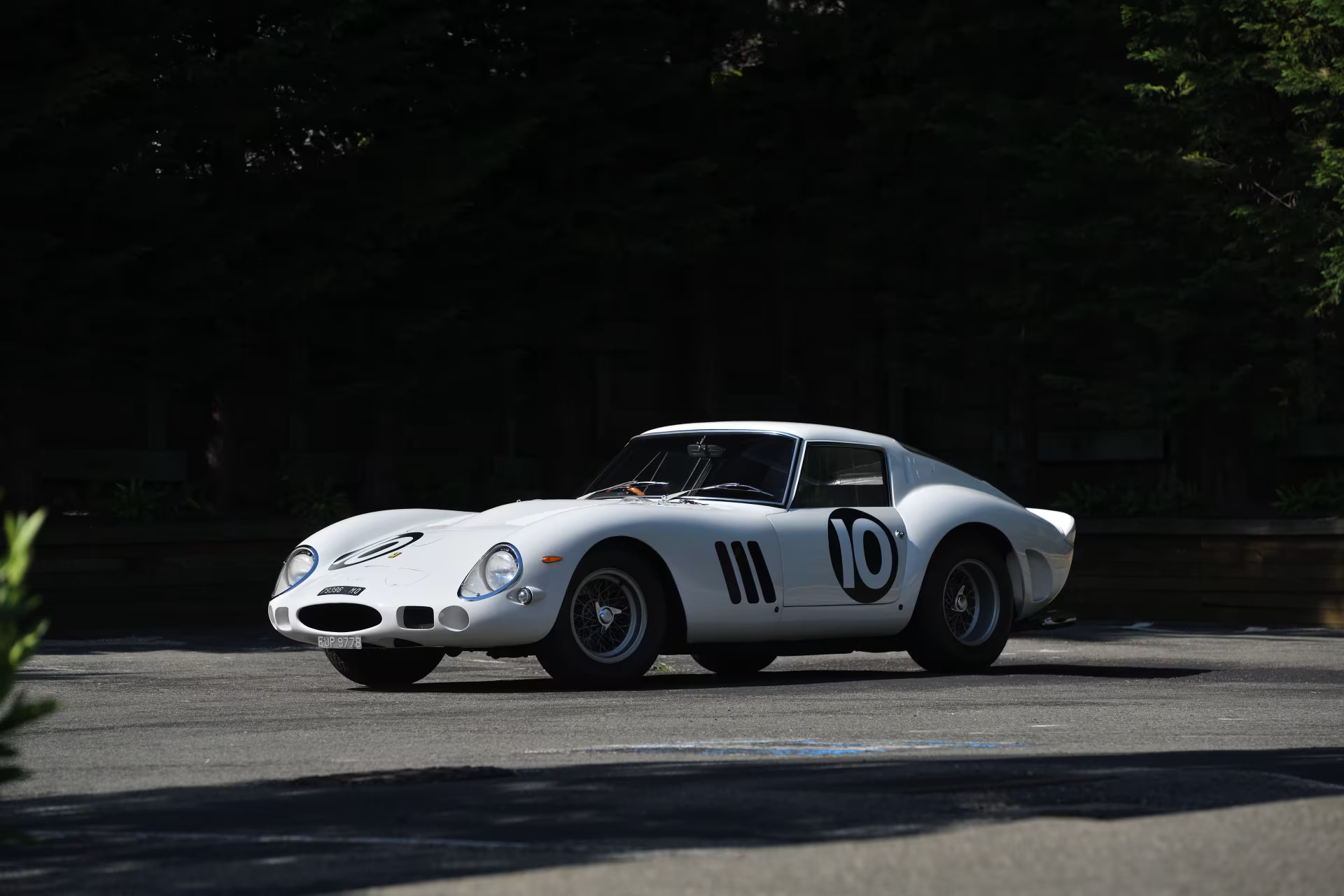
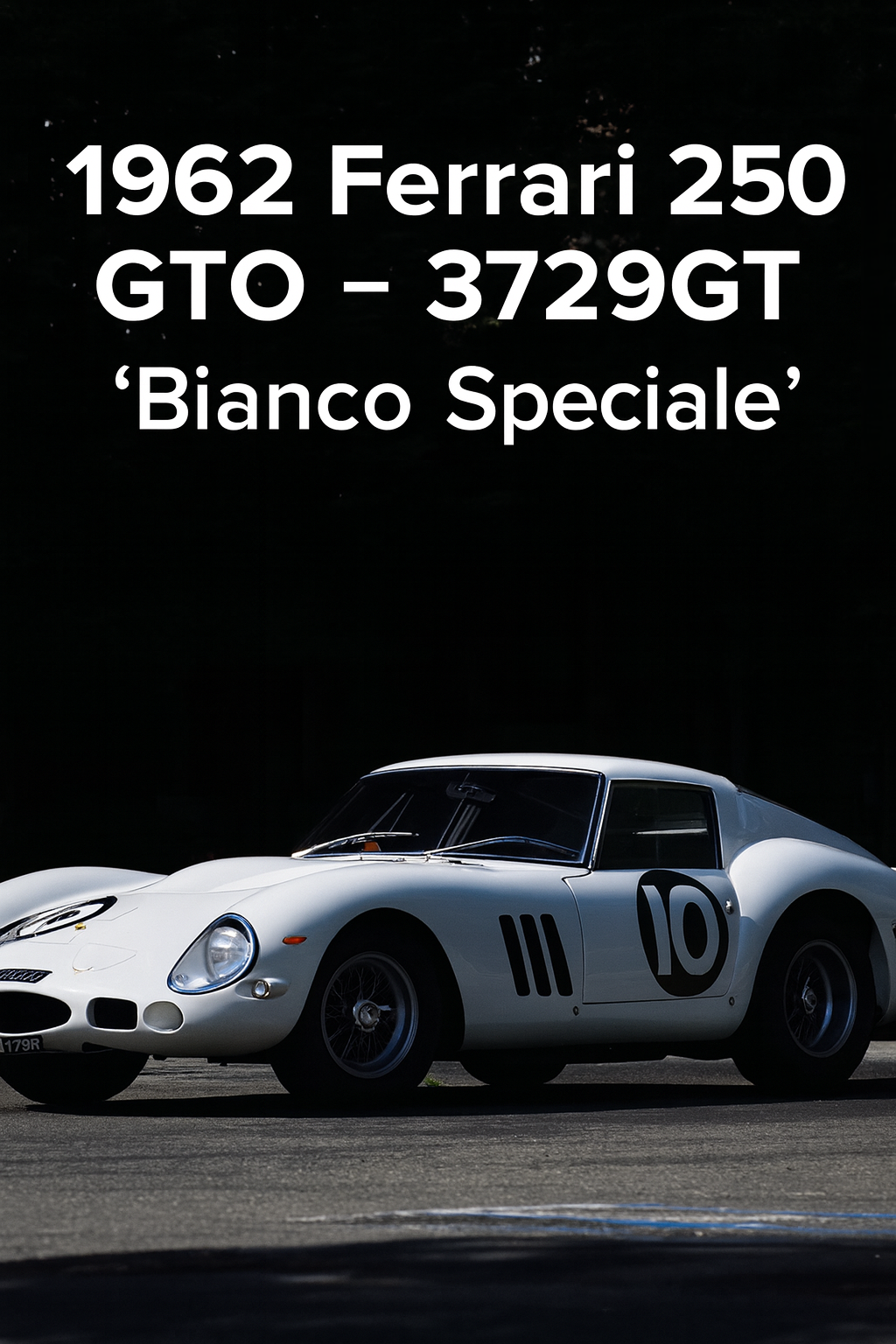
With only 36 examples produced, the GTO is already the crown jewel of Ferrari’s 1960s racing dominance. But the spotlight today is on a singular machine—chassis 3729GT, the only GTO ever delivered in Bianco Speciale (white) from the factory.
Why 3729GT Stands Apart
- One of Eight Right-Hand Drive Cars: Originally sold to the UK, this GTO is among just eight right-hand drive examples.
- The Only White GTO: While most GTOs left Maranello in Rosso Corsa, this car’s white paint makes it a one-of-one. In a sea of red, it stands out unmistakably.
- Interior Details: Delivered with blue trim but quickly retrimmed in black, likely to suit its first owner, British racing figure John Coombs.
Chris Neely summed it up best: “Whether it’s right or left-hand drive, the fact that it’s the only one in white—that’s the spectacular fact.”
A Car with Racing Pedigree
3729GT was campaigned in period by legendary drivers including Graham Hill and Roy Salvadori. Coombs, a Jaguar man at heart, even allowed Jaguar engineers to study the GTO in hopes of improving their E-Type Lightweight program.
The car also featured unique modifications:
- A third cooling vent on the side, believed to be a Coombs request.
- Functional air ducts replacing fog lights.
- Hood louvers to balance cooling and aerodynamics.
Despite its racing life, the car avoided catastrophic accidents. Mike Parkes did have an off in 1963, but structurally the car remained sound—an extraordinary rarity among GTOs.
Provenance and Long-Term Care
- Jack Sears owned the car from 1970 to 1999, a nearly 30-year custodianship.
- John Shirley, former Microsoft president, acquired it in 1999 and became its most visible caretaker. He showed it at Pebble Beach, Monterey Historics, and even Windsor Castle after Ferrari Classiche certification confirmed its originality.
Shirley initially kept the car red, but in 2016, Ferrari Classiche persuaded him to return it to its factory white. Its reappearance stunned the collector world: “There’s a white GTO!”
Rare White GTO - A Classic Car's Amazing Story!
The Motoring Podcast Network: Years of racing, wrenching and Motorsports experience brings together a top notch collection of ...knowledge, stories and information. #everyonehasastory http://www.motoringpodcast.net
► Check out our membership program and go VIP at: https://www.patreon.com/join/gtmotorsports
►► Other cool stuff: https://www.gtmotorsports.org/linksShow More






Auction Spotlight: Mecum Kissimmee
This January, 3729GT will headline Mecum’s Kissimmee Auction, the largest collector car auction in the world. With over 5,000 cars crossing the block, Kissimmee has evolved from a small Corvette-only sale behind a laundromat into a two-week spectacle that sets the tone for the collector market each year.
Murtaugh explained the strategy:
- Early days feature more accessible entry-level collectibles.
- The second weekend builds to “Super Saturday,” where the heavyweights—like this GTO—take center stage.
For the new owner, 3729GT is more than a car. It’s a golden ticket to every major historic racing event worldwide, plus exclusive Ferrari GTO reunions.
Why This Matters
The Ferrari 250 GTO is already the most coveted collector car on earth. But chassis 3729GT is in a league of its own:
- The only one in white.
- Documented racing history with world-class drivers.
- Long-term ownership by respected caretakers.
- Ferrari Classiche certification and a spare “hot rod” engine for spirited use.
As Ross put it, “If you want to stand out in a crowd of GTO owners, this is the car.”

Final Thoughts
When the hammer falls at Kissimmee, the world will be watching. Chassis 3729GT isn’t just another GTO—it’s a once-in-a-lifetime opportunity to own the rarest expression of Ferrari’s most legendary car.
About this Episode
Summary
In this episode of Ferrari Fridays, William Ross from the Exotic Car Marketplace explores the intricacies and challenges of judging at Ferrari concours events. He shares personal experiences and frustrations with the process, particularly around the qualifications and consistency of judges. William emphasizes the impact that awards can have on a car’s value and the dedication required to participate in these prestigious events. Additionally, he highlights the contributions of volunteers, the importance of using cars as they were intended, and promotes various automotive-related sponsors and networks.
Highlights
- 00:00 Deep Dive into the Ferrari 250 GTO; Unique Features of Chassis 3729 GT
- 01:25 Discussion with Guests: Sam Murtaugh and Chris Miele
- 01:54 Right-Hand Drive and Color Rarity
- 03:23 Interior and Modifications
- 08:22 Racing History and Ownership
- 13:41 Restoration and Certification
- 18:20 Documentation and Provenance
- 19:03 The Red Book and Ownership History
- 19:29 The Evolution of Mecum Kissimmee Auction
- 21:05 Organizing the Auction Days
- 23:47 Entertainment and Activities at the Auction
- 24:49 The Role of Social Media and Broadcasting
- 25:41 The Story Behind the Cars
- 26:25 The Ferrari Collection at Kissimmee
- 26:49 The GTO and Its Journey to Auction
- 33:04 Preparing for the Auction
- 35:46 Conclusion and Final Thoughts
Transcript
Crew Chief Brad: [00:00:00] As part of Ferrari Fridays, William Ross from the Exotic Car Marketplace will be discussing all things Ferrari and interviewing people that live and breathe The Ferrari brand. Topics range from road cars to racing drivers to owners, as well as auctions, private sales and trends in the collector market.
Never, never.
William Ross: Welcome to the Ferrari Marketplace Podcast. Today we’re gonna take a deep dive into the legend itself, the Ferrari two 50 GTO with only 36 ever built. The GTO sits the top of the collector car market with its racing pedigree, unmatched beauty. Its history with some of the motorsports most prolific drivers.
It is the ultimate expression of Ferrari’s 1960s. Racing dominance. But today we’re not just gonna talk about any GTO. We’re specifically gonna talk about chassis 3 7 2 9 gt. This is the only two 50 GTO that left the [00:01:00] factory in Bianco’s, Speciale, or for us that don’t speak Italian, that’s white. We believe it might have been at the request of John Coons being that he was British and didn’t wanna have a red car, but one of my guests might be able to delve into that a smidge.
And for now though, but the first time in, geez, multiple decades, this GTO is coming to auction. Specifically, it’s gonna be coming to Mecca’s Kissame Auction in January, the world’s largest collector car auction event today. Joining me also on this is gonna be Sam Murtaugh, COO of Meum Auctions, and Chris Neely from the Prancing Horse of Nashville.
So gentlemen, welcome to the show. Thank you.
Sam Murtaugh: Thank you.
William Ross: So let’s just jump right into the car itself. This specific GTO, there’s some really great specifics about this car that make, in my opinion, one of the more collectible ones of the 36. You know, I mean obviously all of ’em are collectible, but you know, there’s some really good specifics about this car itself that I think makes it kind of stand out from the other ones.
It’s just one of eight right hand drive cars. My opinion outta 36 1 8, that kind of makes it a little bit more [00:02:00] special. Chris, what are your thoughts on that? Being one of only eight right hand drive cars.
Chris Miele: Obviously it was sold to a UK owner, so the cars are right hand drive. It’s the car that he preferred to have.
I mean, they’re just used to it. For us in the states, it’s a little odd for us, but I mean, right hand drive cars are super desirable in certain markets.
Sam Murtaugh: One right hand drive cars, which obviously shrinks the rarity from 36 down to eight, but the fact that this is painted white, it is the only one painted white from the factory, basically being the only one, regardless of the right hand drive, the only one painted white of the whole group is the most powerful piece of this car from my perspective.
I mean, whether it’s right or left hand drive, whatever you like, but the fact that it’s the only one in white, that is the spectacular fact to me, from a rarity standpoint.
William Ross: I agree. I think it looks spectacular and white myself, that’s for sure.
Sam Murtaugh: Yep.
William Ross: Makes it stand out. And especially the fact that, you know, you had a lot of ’em that have been repainted different colors and that, but this day and age, it’s always good to have it go back to its factory color, being that one of one, you’ll know which special car you have out of all of them.
Sam Murtaugh: No, no question. I mean, if you wanna stand out in a lead crowd of which, of being an owner of A [00:03:00] GTO, what you at the, you know, the highest of the pedestal, but to have the only one in white and to stand out in white, I mean it, to see, it, it just, the white color in that car and the lines in that car, it’s, it’s, it’s spectacular.
William Ross: Most definitely, definitely. Now. Do we know specifically why that left a factory in white? Was it at the request of cos? I believe so, yes. At least wasn’t green, but white looks very nice on it. Another great thing, or I guess, special, unique thing about this car itself is everyone that is familiar with the nose, GTOs.
They all think they have blue interior. That car actually came with the, from the factory in with the black interior?
Chris Miele: No,
William Ross: it came
Chris Miele: with a blue interior, but when it immediately was delivered in period with the number 10 on it, it was the car that was run by Graham Hill. From the best of my knowledge, I believe that the car had the black seats, and that was only weeks after the car was deliver.
So I think that’s what they changed up on it when the car got delivered to the uk.
William Ross: Wondering why they would do that so quickly, switching from the blue. Well, did all the, uh, GTOs [00:04:00] come blue and black or was there
Chris Miele: another color else came in? No, there was a few different colors. There was some that were delivered with red.
There was some that were delivered with green. There was even black interiors. It was just something at the time they used almost like a Nomex type material. So the driver wanted to slide around in his, in his overalls, in his racing suit. It was almost like a vinyl on the sides that was used on the side bolsters.
But the seats are very, very, very small seat that’s in that car. It’s super easy to retrim and put, you know, whatever color you want it, but I’m assuming that Coombs, that was his look, his livery that he had was white with black ’cause it was obviously requested that way.
William Ross: But anyone out there listening knows why they did it so quickly.
Shoot me a message ’cause we’d like to know if we get an answer that that’d be fantastic. But, uh, that’s good to know. ’cause I always, I think of blue when I think of GTO on the interior, something that would stand out. But black, white, interior, fantastic. Coombs actually being a Jaguar guy sent the car over to Jaguar for them to guess reverse engineer it, to try and get their Jaguar up to speed.
’cause the [00:05:00] GTO was so fast. What do we know about that little story? ’cause it’s never been confirmed, but it’s kind of pretty well known.
Sam Murtaugh: Coombs, you know, was. As Chris mentioned, he was British and you know, obviously was, was heavy into the associate with Jaguar and, and it said that Jaguar engineers wanted to get their hands on that to figure out what’s going on, why, what’s making this car so great.
And to be able to have an opportunity with the relationship with Coombs and, and get their hands on, on a GTO to, you know, looking into that car and, and. Figuring out what they could use from that to prototype their lightweight e types.
William Ross: Coombs did a few special things to kind of, I wanna say differentiate.
I don’t know if make it better. What did Coombs do to the car itself? Do I guess, in his mind, improve it?
Chris Miele: Coombs, I believe, put the increased cooling in it, so the third vent. Most of the cars have the two vents on ’em. This car has three vents on the right hand side and he made some other small modifications to the car ’cause he was obviously competing with the car and they were showing the car and running it everywhere they could in the uk.
Sam Murtaugh: The louvers on the hood I believe was something cos added and I think air ducts in the front, I think he replaced those fog lights and made those [00:06:00] functional air, I believe. I’m not mistaken,
Chris Miele: he did make some small ones. There’s a photo of the car with Graham Hill running the car and it’s got the three vents on it.
So you know, it was definitely a three vent car originally because there’s other photos when you look at it. The green one that I mentioned to you, that it was actually a little bit earlier car, and there’s cars that were later than it that actually had the two vents as well. So there had to be a point with ti when they went ahead and they built the body on these cars.
It had to be a request, but it wasn’t something that Coombs, you gotta be clear about that, that it was added afterwards. There’s a few of them that have the three vents on the side. There are a few cars that have the three vents because you can clearly see it in the photo. They had those three vent holes in the front, but.
There’s other ones that were in the bonnet and you know, cars had, you know, different things in them. This car, uh, it hasn’t been modified. This is the way that this car was ordered.
William Ross: The vents on the hood on the front or in the nose. Can you open and close those? Yes.
Chris Miele: In
William Ross: motion?
Chris Miele: No, not in motion. [00:07:00] No. You just go ahead and they have.
Quick fasteners on ’em and you just put ’em in. So they obviously did it for cooling because if they don’t want the car to run too hot or obviously too cool
William Ross: at Lamont specifically, or, and a lot of the other tracks back then, they had a lot of very long straits and obviously aerodynamics come into play, wasn’t it?
Early cars, they came to the conclusion or realized that it was having a lot of nose lift at higher
Chris Miele: speeds. Yeah. That’s when the early days of aerodynamics were really starting to kick in and they started to figure out, we gotta go ahead and keep this car cool or hot. But you know, the more openings that you have on a car, the more it slows it down because that’s just that much more error that’s not slipping over the car, it’s going into it.
It’s kind of the balancing act at that point. If you look at the grill on a two 50 GTO, it’s quite small. Yeah. And as a sidebar, when you look at the car, like the 2 75 car, the hen car, the the sister car to Dana’s car. During the race, they had to get wire snipers in 65 and cut a giant hole in the front of the car just to get more air into the car.
And that’s really the successor to the two 50 GTL.
William Ross: Always keep in mind that, [00:08:00] you know, yes, you could drive ’em on the street, but these were race cars. That’s what they were built for back in the day. It was to compete. People would sit there and look how minimalist the interior is and what it’s got. It doesn’t have any creature comforts.
This thing had one purpose and that was to go fast and win races, extra cooling, everything would be critical back then too, especially. Front engine V 12 is gonna need to breathe as much as it possibly can.
Chris Miele: Sure.
William Ross: This car’s really, it’s never been, I wanna say wrecked, but I mean it might’ve had a ding or two or here or there, but it’s never had anything of serious consequence where quarter panels, all this stuff had to get replaced or anything like that.
Pretty solid as an original car. Right? Well, Mike Parks had an
Chris Miele: accident with it in 63, which is well documented. You know, it had its battle scars and, and the way that it worked, if you were racing for Ferrari, if you weren’t pushing the car right to the very edge. You were no longer gonna be a racing driver for Enzo Ferrari.
It was first or nothing with them. You know, it didn’t, it wasn’t, you know, second or third place, they weren’t satisfied with that. It was win at all [00:09:00] costs and the drivers put the cars to their limits and they pushed ’em right to the edge. And sometimes they went a little bit over the edge. But to your point where you mentioned earlier, was it completely in an accident, some of the other GTOs have had some catastrophic crashes.
No, this car didn’t it, it was raced in period. It had its battle scars. As they say, structurally, the cars is sound. And it’s, you know, the, the way that the car always
William Ross: was. Yeah. That’s fantastic. Some of these have been, I would say, damage bound recognition, but you know, they have some significant damage and having something that’s that original close original is fantastic as well.
For sure. Let’s get into specifically 3 7 2 9 GT Ferrari, two 50 GTO in the, uh, build sequence. When was this one built?
Chris Miele: Number 12.
William Ross: Okay. So they had some, I guess you would say testing or I’d say racing done prior to that one being built. So they probably modified that after knowing that that needed more cooling.
Chris Miele: Yeah, and it, and it’s funny, on the most part, the cars were all the same. One of them has a different differential. Two of them actually have a different differential in them, and then there’s some that, [00:10:00] you know, have a stripe on ’em, which is noted obviously originally how it left. But this was the third one for the uk.
So I believe it’s the third right hand drive car, at least what I’m seeing here. It’s number 12. Most of ’em are Rosana, but some of them are. Rosa Corsa is what it shows here, which I don’t know if that’s a screw up in the computer or not. I didn’t know that that was actually a color at any point until way, way later racing red.
Oh no, it actually, no, no, no. It is though. I see another car with it as well. I see three cars with it. Yeah. It’s quite unique. This car. But it’s definitely, when I look at this car, 3 7 2 9, it’s the 12th one that was produced.
William Ross: You know, one thing that I think is very special too, and what’s great about this car is the long-term ownership history that this car’s had.
Chris, can you touch on that a little bit? Regarding to basically just only a really a couple owners,
Chris Miele: Jack Sears had the car from 1970 all the way to 19. 99. I mean, he had a, a long ownership with the car. That’s when John Shirley purchased the vehicle.
William Ross: [00:11:00] 30 years is impressive for keeping a car of that nature’s.
What did he buy that car for? I, it wasn’t all that much back in, what was it, 71, he bought it.
Chris Miele: Oh yeah. So in 1971, that car probably at the absolute most, would’ve been probably 10 to $15,000. I know that the Nick Mason car was sold. For about 35 to $40,000 from Ronald Stern to Nick Mason in 1978 or 79, I’d say in the early seventies, it was probably somewhere around 15, maybe 20,000, somewhere in the neighborhood.
So it’s, it’s quite the investment when you really look at it.
William Ross: Yeah, a little bit. Yeah, that’s a nice return. You know, and I, A little side story, Nick Mason utilized his car’s collateral to fund, it was the mid eighties Pink Floyd reunion tour, whatever. They put that up as collateral, I dunno, it was like a million bucks or something like that to be able to pay for their tour.
That came back tenfold just on the tour alone. So that’s always kind of an inching little story at that. Great story after. Sure.
Chris Miele: Yeah. John Shirley got [00:12:00] the car in 1999. John, I believe at that point in time was only shortly thereafter, he was still working. You know, he was the former CEO of Microsoft and he got the vehicle and he used it quite a bit.
I mean, he took it to all the Caino classics. He took it to the Monterey Historic Races. I mean, he really, really had a lot of fun with the car and showed it off, and everyone, as Sam mentioned, knew it as the white Ferrari, GTO. It’s a real special car and obviously, uh, John was heavily involved with, you know, a lot of other things that he did at Pebble Beach as far as showing other vehicles and doing Concor events.
So he is a well-known name, so he did it from all sides. He was not only showing cars, he was doing track days with cars and heavily involved with doing everything, even involved obviously with Froy class CK, getting the car certified. With Ferrari Classic K.
William Ross: He’s been an outstanding caretaker and obviously we can see for multiple decades, which is great.
Then the previous owner of that, Jack Sears, you know, he had it for 20 plus years [00:13:00] himself, which was great to see, and they thoroughly enjoyed the car. If you look at the history on that racing historics and everything like that, that car was out there in the public beauty in motion, I guess you could say.
I mean, it’s just a fantastic car. Chris, you touched on, you know, the car’s obviously got its red book. It’s got the classic case certification. That’s Ferrari going through and saying, yes, this is how this car came from the factory for this auction itself coming up. What would need to be done or what gets done to the car itself, especially a car at that level, getting it ready for the auction.
What gets done prior to the auction,
Chris Miele: John, he has his own gentleman that works for him, Fred, and they really take care of all the cars. The cars are extremely well maintained. The whole collection that he has. And this car in particular, obviously was no different than any other one. That being said, when John first had the car, it was red.
When he first purchased the car, it was red. And then in 2008, I believe the car got the classic case certification and that’s when they went ahead and they, Ferrari made a new engine block. That was installed in the car and it has the designation on there, the internal number, [00:14:00] 2300 slash 62 EE for Echo, which designates that it is a GTO motor, which is done right from the factory.
So at some point early in its life, the engine was replaced. It was a two 50 short wheel base competency on engine that was put in for some time. Then there was a two 50 GTE engine that was put in, but right now it has the proper specification motor that’s in there. From the factory. So the car was mechanically maintained, but it was never restored.
The car is still not a complete frame wall for restoration. John had the car, it was Red John used the gentleman, I believe Butch Denison did the car up in Washington State and he brought the car back to white. But initially, John Shirley wasn’t convinced to make the car white. It was the guys at Ferrari Classic K.
It was actually Marco Origi who really pressed the issue with him. And then sure enough, John painted the car in 2016, I believe, and then the first time it came out was at Windsor Castle in the uk. And that’s when you know the big puff was, Hey, [00:15:00] there’s a white GTO. Because for many, many, many, many years, the car was red.
I don’t think a lot of people knew, and the internet isn’t what it is today. I mean, every year it seems like the internet evolves and there was no ai, you know, unless you went ahead and scrubbed it and found photos. Many of the photos that you found were from very, very early in the days. But for a good period of its time, the car was red and now it’s back to the original way that it left the factory, which is white in
William Ross: the collector car world.
There was that period where it was like basically restored to better than new, not so much. Really follow, Hey, this is not left the factory. Then all of a sudden we went into the barn finds and everything, but then all of a sudden, hey, let’s go back to originality. It’s fantastic. He did that, went back to the white and he got talked into or convinced that, hey, that’s the way to go.
And obviously it turned out I think it was an excellent choice ’cause it just stands out from the rest because you get it all lined up. Red, red, black, just one white one, stick it in there. So I mean it’s, it’s great to see for sure when you
Chris Miele: look at the list and you look at the original colors from the factory, you know there’s some obviously silvers green.
But to your point, primarily ena, I mean most of ’em are
William Ross: red mentioned, the [00:16:00] engine block it and recast and looking at description, what you guys have that that’s coming with another motor, correct?
Sam Murtaugh: Yeah. The engine that Chris described is in the car and, and there’s a spare motor that will come with it. So John, for as many events as he participated in, you know, was to, to be able to have a motor like that that you could really get after and get on and not worry about and you know, be able to protect.
The engine that Chris described and make sure that that stays as pristine and proper as it needs to be. But having another, another engine to be able to use to, to drive the car. John drove the car, he drove it respectfully, but he, but he enjoyed, you know, when we were out there with him a couple of months ago, you know, he very explicitly stated, you know, that cars are meant to be driven.
These cars are meant to be enjoyed. This race car is, wants you to drive it. So being able to have that ability to drive it and drive it. I mean aggressively as you want to, but in, you know, not to worry as much about the motor. You’ll have that opportunity to swap a motor if need be for the new owner.
Chris Miele: Hot rod motor.
That’s what he calls it.
Sam Murtaugh: That’s right. The hot rod motor.
William Ross: Well, that’s common too with a lot of higher [00:17:00] value cars like that, is they drop in a different engine and keep that one safe, which is great. ’cause that means they’re getting out there using their car and participating. Right. This day and age, there’s so many historic events that you can participate in you across the globe.
This car will get you into every single one, no questions asked. I mean, that’s like your golden ticket to participate in all these events. So whoever the new owner may be, the palace is open, so to speak. In regards to just attending any event you’d want, and not to mention, I dunno if you can confirm it, but don’t the GTO owners do their own kind of little private events every few years?
Chris Miele: They did. So a few years ago they had a couple different reunions and if you look it up. You’ll see that they had the 50th anniversary GTO tour in 2012 and they actually had another one they put together with Kena who runs Caino events and they gotta get together and they try to get as many of the guys together.
But it’s a real special crew. Obviously the gentleman that have the cars and you know, some of the cars have swapped in and swapped out, you know, the Rick Workmans and different guys like that that had the [00:18:00] cars and they’ve sold them. But for the most part into what you mentioned earlier, you got Nick Mason, you got Anthony Bamford, you got Brandon Wangs, you.
At all these different guys that have had the cars for long term ownership and they do get together for a reunion every so many years. It’s not every single year. It seems like it’s every few years. I think
William Ross: every five, to be honest. What’s the amount of documentation is car comes with? ’cause I think that’s one thing that’s key, especially in these higher value cars, is documentation history.
I mean what like documentation wise, what’s gonna be coming with the
Chris Miele: car? Sam can probably touch on that because I didn’t see the documentation, but I know that there is. Plenty of stuff with John
Sam Murtaugh: for sure. I have not physically reviewed all the documentation, but I did see a couple of big books sitting on the desk with a lot in there.
I mean, I was amazed at how much, how many historic photos of, of all the different races that this car participated in at the beginning, you know, 62 to. 69 ish or 68 ish, something like that with all the different photos, photo documentation we have on this car and, and as it went through all the different drivers and the different races [00:19:00] that it was participating in, as was pretty impressive.
Obviously the Red Book and the ownership history is documented all the way back to the beginning. It’s got good stuff,
William Ross: be impressive. And I’m sure it would take someone a few weeks to go through all that. And just as us being all car nerds, we’d sit there and eat it all up. Just every single line. ’cause just seeing that history, knowing what that thing did, where it raced, who’s raced it, I mean, ’cause you got, you know, Graham Hill, Roy Salvador, I mean, it’s just unbelievable.
The people that have gotten behind the wheel of that car, put it through its paces back in the day is just unbelievable.
Sam Murtaugh: Yep.
William Ross: I wanna talk a little bit more about Mecu Kissie itself. ’cause this is becoming the preeminent auction of the year. Not just volume, but the quality of cars you guys are getting.
Sam, how’s this evolving where you guys are starting to get a lot more of these highly collectible elite cars and how’s this changing Mecca’s DNA in regards to, its like core brand
Sam Murtaugh: and I’ve been with the company, I think this is my 18th year. 18th or 19th year. And so, you know, I, I think I was 2004 or five was my first Kissimmee auction.
The auction, I think, started in 2000, was the very first one, which [00:20:00] started buying the laundromat in Kissimmee, in, in Old Town, and evolved over to the, uh, I think with like 50 cars in it. And then by that time it, it moved to OCL Air to Carriage Park. When I was first there, the auction and the cars were all inside in one tent, the corner of the property.
But every single year. Since then, it has grown almost double every single year, year after year. Started out with a couple, you know, when I was there, it was probably two or 300 cars. Started out as an all Corvette only auction. Think in conjunction with an NCRS event that was down there. Dana decided to open up to all types of cars and it really just took fire and never looked back.
And it has, it’s grown and grown exponentially year after year to somewhere around 2010 ish. It, the hold is the world’s largest electric car auction with the volume of cars that were at one event. And continue to grow past that. We’re pushing 5,000 cars now, so from 50 cars behind the laundromat to 5,000 cars in 13 days long, it has just become a spectacle.
It’s the greatest car show on earth, in my opinion, far as where you can see, you know, every type of [00:21:00] vehicle that you can imagine is there that week, and it really sets the tone for the collective car market for the rest of the year.
William Ross: How do you guys go about, you know, having that volume of cars, obviously over multiple days.
How do you start organizing, okay, we’re gonna have these go on this day, these on this day, and I love it, the moniker, leading up to Super Saturday when you have all the big hitters. I mean, how do you guys kind of go about. Figuring out what goes where.
Sam Murtaugh: Anytime you put four to 5,000 cars in, in one place, you know, how do you disseminate what needs to go where and how do you do that?
And we do that by value. You know, the, the weekends are our most attended events, both the first weekend and the second weekend are the, are the most heavily attended. So, you know, the, the very first day, day one will be, you know, relatively expensive. What we like to refer to as entry level collectibles.
Things of people that are just looking to get into the market, dip their toe in the water and, and get into it. We’ve got a lot more affordable cars in those early days. Sort of apex and lead ourselves into that first weekend. And we get some really great cars. That first weekend type of quality you would see in some of our bigger days at at some of our other events throughout the country throughout the year.
[00:22:00] And then we do a bit of a reset. There’s sort of two big crowds. You have the first weekend crowd, which is a little bit more regional. Then the, the national and international crowd starts to come in day after day as we lead into the second weekend. So Tuesday is slightly smaller, then it gets bigger on Wednesday, which gets bigger on Thursday, bigger to Friday, and then onto Saturday.
And everything culminates at the, the peak on Saturday. So Friday and Saturday, the second weekend are our two biggest days. It’s heavy metal from start to finish on both those days. So the cool thing is, anyone that’s in the hobby or whatever level you can get involved in Kissimmee and be a part of it and connect with it, you know, whether as a buyer or a seller, but even as you know, from a spectator’s perspective, to see cars that are pretty attainable up to the aspirational vehicles that to watch these guys.
Trading high dollar, extremely valuable cars into that second weekend is, is what makes Kissimmee so special.
William Ross: Great. ’cause a lot of people, either it is their first collectible, the only collectible they’re gonna buy, but to your point is there’s something there for everyone. Not just price point, but style, genre heavy.
I mean, there’s something there for everybody.
Sam Murtaugh: You know, in cars like this, GTO that we’re talking about here, I mean obviously [00:23:00] is the headliner for Saturday, the second weekend as Kissimmee continue to grow and the international attention that it receives and the amount of people that come to it, all 50 states in the, in the United States and, and from, I think it was 30 different countries around the world that participate in this event.
The fact that we have that big of an audience and that amount of eyeballs focused on one location at one point in time has really opened the eyes to a lot of folks to realize that if I wanna sell my car and I wanna bring the most attention to it in one place and and maximize the exposure, Kissimmee is the place to do that.
And I think that the more and more people realize, you know, you can take a car like this and go to Monterey and compete with six different auction events going on the same weekend, on the same day at the same time. Or you can put this car on a pedestal in front of an international audience that’s arguably bigger.
And find success
William Ross: being a multi-day event over, you know, a week and a half, two weeks roughly. What other events also go on during that? It’s not 8:00 AM to 8:00 PM it’s cars going across the block. What else do you guys have going on there?
Sam Murtaugh: Well, it is 8:00 AM to 8:00 PM with cars going across. Oh, it across the block.
Oh, okay. That does happen. Oh yeah. No, we’re bell to be, we’re selling [00:24:00] 350 on or on some of the days, almost 400 cars in a day. To sell that many, that amount of cars, you have to work that hard and, and work that long. But the event itself, we’ve got entertainment going outside with music and things going outside an adventure zone for kids, for families to come out and enjoy themselves and they can get involved and do, you know, automotive orientated events with the kids?
We’ll have speakers and, and seminars going on at our midway stage out front. We do car parades, you know, the cars don’t just sit on display forever until they’re time to go to the block. We do some hand selects and we do car parades across our midways like we like to call it, so folks can sit and watch the cars, run, drive, listen to ’em, huge food truck area.
I think over a dozen food trucks that are out there with all different types of food for people to get involved with and, and hang out. It’s just a, from a car enthusiast perspective, it’s like Disneyland or Disney World, I should say, as we’re in Orlando, but. There’s just a tongue going on. It’s a, it’s very stimulating
William Ross: this day and age too.
How has, you know, working social media, YouTube, and obviously you guys are broadcasting now too, how has that changed your guys’ approach and has that really helped you guys acquire and grow [00:25:00] in regards, not just volume, but cars, you guys are getting.
Sam Murtaugh: We’re very much also in the entertainment business. Our auctions are broadcast live on ESPN, ESPN Plus we launched, uh, mecom TV on the Roku channel.
So we have 24 7 Mecu auctions rolling. We’re produc content for that. We’ve, we’re nearing a show on, on the GTO, on Mecu tv, you know, between YouTube and all the content we produce for that social media. Insta, we have a, a whole team dedicated to social media from Instagram. Facebook and TikTok and all the like, and you know, we’re very much an entertainment company just as much as we are an auction company now, with the kind of cars across our block and the, and the the cool stories that we’re able to tell.
We’ve got content coming out of our ears and we love telling the story about video and it’s, it’s fun. It’s why, it’s why I got into this.
William Ross: Yeah. I mean that’s one great thing about this industry or just cars itself, is knowing the story behind a lot of it. ’cause a lot, every car’s got a story. It’s fantastic to learn a lot of these things and delving into those creates, I don’t wanna say a mystique, but it really kind of can grow and make that car special.
Sam Murtaugh: No, absolutely. I mean, the amount of cars that we see year after year, I think Chris wouldn’t feel the [00:26:00] same. I mean, we’re in the cars are our work. That’s our life. That’s what we do day in, day out every day. But when you find a car with a great story behind it and the people that you meet because of that story or the connections that you make because of that, that’s what makes this stuff cool.
The cars are great and then people ask us all the time, what’s your favorite car? What car do you want? It’s, to me, it changes all the time. I mean, it’s, it’s about the people and the stories that you hear and learn and the connections that you make along the way is what makes this this hobby super cool and fun and, and great to be a part of.
William Ross: Looking at it, we have 70 plus Ferrari. As of now, basically going across the block down and kissing me. You know, obviously Callate in the GTO, but you have a very, very nice selection of Ferraris that are gonna be crossing that block.
Sam Murtaugh: Absolutely. Probably one of the best collections of Ferraris that we’ve ever offered for sale.
William Ross: Yeah. The Bachman collection, which we’ll do in a couple weeks. We’re gonna do an episode on that one as well. ’cause there’s some very special vehicles in that one as well. Mm-hmm. Chris, I’m gonna have you kind of touch on this, MECU, obviously what they’re getting now and get involved in the level of cars they’re doing.
I mean, it’s just top notch. What was the choice? I mean, going to Mecu, what [00:27:00] was the thought about, hey, let’s, this car is gonna be best served at Mecu?
Chris Miele: So what happened was, originally I was at Retro Mobile in Paris and you know, doing your normal visits, you’re meeting all the different people. I bumped into one of the Pebble Beach judges.
His name is Richard Ado. He is also an author and writes some great books on French cars. We had a really good dinner together. You know, we met the year before and had dinner as well, and then the following day he went back to Washington. He is a very good friend of John Shirley. A couple weeks later we had the event that was at Amelia Island, and I see Richard as I’m checking outta the hotel and he says to me, uh.
Hey, where you heading back to? I said, I’m heading back to Orlando, catching a flight. He said, you mind if I tag along? So he jumps in the car. We’re probably an hour into the ride, and he looks at me and he says, Hey, you got anybody for John’s two 50 GTO? I almost went off the road to be honest with you, and I looked at him and I said, you’re serious?
He said, yeah. And the first person that popped in my mind was Dana, because Dana’s a collector. I picked up the phone that evening. I called Dana and we had a chat. Dana said, listen, you know, I was already involved [00:28:00] with helping Dana with the 2 75 lm. We were restoring that car, and I was looking after that project in Italy.
I said to him, which is, is this something you’d want to add to the collection? And he said, you know what? Let’s have a conversation with John. We had a conversation with John. We went out there and Dana, John, myself, we all sat together. The decision was made ’cause it wasn’t something that Dana was gonna put into his collection.
It was best suited to bring it to public auction. Obviously John’s still the owner of the car, and we connected Dana and John together and it was a match made in heaven, as they say, because as Sam pointed out, you know, and you pointed out there’s over 70 cars going to Kissimmee. We’re gonna talk about the Bachman collection in the future, which is a real special collection.
To my knowledge, I don’t know of any Ferrari collection or this amount of Ferraris that’s ever been presented at one auction at one time, ever, at any point in time. So it’s super exciting. You know Dana, from a personal level, he’s got a an amazing Ferrari collection. He’s a real true connoisseur to the brand.
He shows his cars. [00:29:00] He’s obviously involved with Pebble Beach. He does the Caino events, he does the Amelia Island events. Dana’s obviously the right guy that’s personally involved. It’s not just a business. Dana has a true love for the cars. I really honestly felt, you know, when the conversation came up and it just evolved so quickly, it really, really, really went well and it was great to be part of it, to see the meeting with John and obviously with Dana together.
It was, it was a great, great time
William Ross: and it’s, and it’s worked out well. That’s what awesome thing about Dana is, you know, he is a true collector. I mean, he has a passion for these cars as well, and seeing his unbelievable collections, you know, fantastic as well. When Dana kind of dropped that bomb on everyone else at Mecu, what was the thoughts and enthusiasm around the offices?
Sam Murtaugh: Our marketing team got extremely excited really quick. I mean, you know, obviously, you know, the nice thing is, you know when, when you’re as promoters of auctions and you know, with headliners and headliners like this, especially to get. As early as we’re able to do and be able to kick off our Kissimmee campaigns with a car of this magnitude was exciting for all of us and to, you know, really, [00:30:00] you know, set the tone, set the tone early and March towards January.
I mean, we, we announced the, the GTO was coming to Kissimmee. We announced it in Monterey in August, that our auction air being able to, to launch the campaigns for Kissimmee in the middle of August with a headliner like this, GTO. It was the best. We were excited.
William Ross: Not just that car, but the amount of other Ferrari they’re gonna be crossing the block and kissing me.
This is really gonna kind of set the tone for the market because you know you have your top end, I’m not gonna say bottom end with like some three oh eights and three 20 eights, but. This is really gonna kind of set the tone in regards to where the market’s going into 2026. In my mind, it’s kind of a big responsibility in regards to all the eyes that are gonna be on You guys
Sam Murtaugh: we’re up to that task.
That challenge in Kissimmee for years now has been that market tone setter for whatever type of vehicle for all the different markets, right? So. Whether it be muscle cars or Corvettes or Ferraris or, or whatever. I mean, you know, the fact that we kick it off in January, we start the year off with such a bang with this auction, it sets the tone for the market for the rest of the year.
[00:31:00] No doubt about it. So we do it on an annual basis and we’re excited to do it for Ferrari.
William Ross: As you delve into these more, do you guys see yourself. Stick into your true path in regards to how you guys do your auctions? Or do you see yourself doing something a little different with like, say, a separate high end type situation?
Sam Murtaugh: We do it all together, but we also, we do what’s necessary for the different types of vehicles and set the stage. I mean the displays that we put together and produce in Kissimmee or our second to none, and we will do these cars justice for what they deserve. And you know, having the opportunity to have these on display is a hell of an attraction for the people that come just to watch the show.
But to segregate. Where we position these cars in the auction, how we put ’em on display, how we represent them, how we present them. It’s taken Kissimmee to another level. Once again, as I described, as we continue this growth trajectory for Kissimmee and adding this layer on top of what’s already extremely successful and, and has become the world’s largest collector car auction, they have this on top of that is, is incredible.
We’re proud to do it. We’re proud, we’re excited to have it. We’re pleased that the, you know, the [00:32:00] sellers have given us the opportunity to present these cars for sale at auction in Kissimmee, and we’re excited to see what the results.
William Ross: Yeah, it’s gonna be a packed room, that’s for sure. And I know I plan on trying to be there for it as well, especially seeing all this go across because it’s gonna be fantastic.
Yep. Chris, when was the last time your GTO crossed the block open
Chris Miele: auction like this? A couple years ago, there was one that passed over the block and there was a series two that passed. There’s never been a white one. No. That’s what sets this car apart and, and look, you know, we kind of touched on it earlier about, you know, Sam mentioned it, I talked about it a little bit, John, how involved he was and some of them cars, you know, they’ve been restored.
There was one that was totally restored and it, you know, it didn’t look like that obviously when it left the factory in 62 or 63 when that particular car left. This car has a real period correct feel to it. It’s just an amazing car. And then, you know, on top of it you have the hot rod motor. It’s white.
The provenance of who owned the car, who drove the car, Mike Parks, Graham Hill, former, the one world champion. You got really, really, really special [00:33:00] people that race this car in period. It’s, it’s a real special car. It
William Ross: really is. Obviously to bid on this car price wise, where, and I’m not gonna get into say, Hey, what do you think it’s gonna go for?
Because we’re not even gonna touch that. What does someone gotta do for a car at that level, registering, whatnot. I mean, is there anything different they have to do that wouldn’t be say, under different from standard, just registering to bid
Sam Murtaugh: every situation’s different. Obviously, you know, there relationships are big components of this and you know.
You know, if we have someone that’s comes out of nowhere from, you know, somewhere in Europe or that, that we’re not aware of, obviously there’ll be conversations that’ll have, and we’ll set their financial verification up, get ’em registered to bid with an understanding that they have the means to purchase that car.
And, you know, ens are, are always helpful and, and things like that, but you know, it, it gets a car like this, it gets to be a case by case. I mean, you know, rarely do you have someone that just goes and registers a bid online and just, you know, pops outta the woodwork, you know, but it’s, it’s not to say it’s never happened, but it.
Yeah, I mean, it’s, it’s an easy process. Getting registered is easy, you know, getting a hold of us and having a conversation with [00:34:00] our bid services team and, and getting connected. Chris obviously is, is helping with his context and throughout the country and, and around the world. It’s not a overly complex process, but you know, you can’t just log in and push a button without any type of financial verification.
Bid, bid, bid, yeah.
William Ross: Your media pass request has probably gone through the roof.
Sam Murtaugh: Yeah, there’s a lot of, a lot of media attention. There’s a lot of, you know, a lot coming in on that actually, you know, vetting some of these, you know, some of these media folks is probably more difficult than vetting some of these high network individuals with,
William Ross: on your Roku channel.
You guys are gonna doing a, a special on this car specifically, and I would assume that on the Roku gets played multiple times.
Sam Murtaugh: Yeah, it’ll rear multiple times. I think it’s gonna rear air four times a day after we premiere it Thursday, November 6th. It will premier at 8:00 PM Eastern on Mecu CV on Roku.
And then after premieres it’ll, it’ll cycle through and re-air, I think four times a day between now and Kissimmee auction in January.
William Ross: You know, be sure to, uh, check out all of Mecu M’S social media pages and sites ’cause they are doing a wonderful [00:35:00] job showcasing that, what that car is and just how special it is.
’cause it’s unbelievable. And I’m really
Chris Miele: excited about this auction. It’s gonna be the biggest. Ferrari auction at one place on one time ever. You’re never gonna see the quality of cars at one place, at one venue that you’re gonna see at this auction. This is gonna be historic and like Sam said, greatest spectacle on sports.
They always used to say was the Indy 500. Well, this would be the greatest spectacle in in auctions for sure. This is. You gotta be part of it.
William Ross: This is a moment in history, you know, it’s one of those things, it only comes and happens every so often and I think this is gonna be a really special moment and this car’s gonna really be strong and I’m really excited to see, ’cause you know, not just this one, but all the other fris gonna be crossing the block.
This is a moment in Ferrari history in regards to what’s gonna be happening. ’cause there’s a lot of special vehicles. Again, I appreciate you guys coming on. Uh, I look forward in a couple weeks. We’re gonna come back. We’re gonna visit the Bachman collection, which is also gonna be crossing the block down in Kissie.
And that one’s gonna be spectacular in its, its own right. The quality and what the cars are in that [00:36:00] collection is unbelievable. And Chris will be back. Sam, we’ll be back. And to everyone listening, appreciate you tuning in and stay tuned till uh, next time you got it. Thank you. Alright,
Sam Murtaugh: thanks guys. Bye-bye.
Don Weberg: Nobody sells more than Mecu. Nobody. Mecom Auctions is the world’s leader of collector car vintage and antique motorcycle and road art sales hosting auctions throughout the United States. The company had specialized in the sale of collector cars for more than 35 years now, offering more than 22,000 lots per year and averaging more than one auction per month.
Mecom Auctions is headquartered in Walworth, Wisconsin, and since 2011 has been ranked number one in the world with the number of collective cars offered at auction, and is host to the world’s largest collector car auction held annually in Kissimmee, Florida, as well as the largest motorcycle auction held annually in Las Vegas, Nevada.
Mes, road Art and Mecu on Time. [00:37:00] Divisions offer a wide variety of collectibles for live and online auctions. You can learn more and follow Mecu and their upcoming events@www.mecu.com, or you can follow them on social at Mecca Auction on Facebook at Mecom Auctions on Instagram. At Ika on Twitter and at Micham auction on YouTube.
ECM PROMO: For everything from Ferrari and Porsche, Lamborghini and Konig seg, visit exotic car marketplace.com. If you’re into anything with wheels and a motor, log onto the Motoring Podcast network and check out our family of podcasts@motoringpodcast.net. This is the place to find your favorite new show. Next up a shout out to David Beatie and his team at Slot mods.
Who custom build some of the coolest slot car tracks in the world@slotmods.com. Let your imagination run wild. And finally, grand touring motorsports covering all aspects of auto racing and motorsports history. [00:38:00] Check out their ezine@gtmotorsports.org. All the links for our sponsors are in the description.
Crew Chief Eric: This episode has been brought to you by Grand Touring Motorsports as part of our Motoring Podcast network. For more episodes like this, tune in each week for more exciting and educational content from organizations like The Exotic Car Marketplace, the Motoring Historian, break Fix, and many others. If you’d like to support Grand Touring Motor Sports and the Motoring Podcast Network, sign up for one of our many sponsorship tiers at www.patreon.com/gt Motorsports.
Please note that the content, opinions and materials presented and expressed in this episode are those of its creator, and this episode has been published with their consent. If you have any inquiries about this program, please contact the creators of this episode via email or social media as mentioned in the [00:39:00] episode.
Learn More
On Ferrari Friday’s, William Ross from the Exotic Car Marketplace will be discussing all things Ferrari and interviewing people that live and breath the Ferrari brand. Topics range from road cars to racing; drivers to owners, as well as auctions, private sales and trends in the collector market.




Copyright William Ross, Exotic Car Marketplace a division of Sixty5 Motorsports. This episode is part of Gran Touring Motorsports, Motoring Podcast Network and has been republished with permission.