
The concept car is often what starts a new group of fans, waiting hungrily for the production model. Alas, sometimes the concept does not get the green light and it remains a one off.
In this case, the Dino 206GT was indeed productionized but alas, most of the interesting features of one of the most interesting concepts built on its race car chassis were cast aside in the face of production realities — laws in various countries such as how low the headlights can be, etc..
From 1966, the World Sportscar Championship was organized to conform to the FIA’s new Appendix J regulations. The fastest cars were expected to come from the Group 6 Prototype class where there was no minimum production requirement or engine limit.
Running alongside the Prototypes in the World Sportscar Championship would be cars from the Group 4 Sports class. Group 4 cars were typically split into sub-divisions for over and under two-liters. To qualify, a minimum of 50 vehicles had to be built.
To contest the under two-liter Group 4 category, Ferrari created a new Dino-badged model: the 206S, a two liter V6. “Dino” was the nickname of Ferrari’s son Alfredino. who died while in his ‘20s, while working as an engineer at the factory.
The plan for the 206S race cars was for them to be run by a works race team, and the rest sold to private racers. But alas, there were labor strikes then and they couldn’t get enough of them built to meet the minimum.
Only 18 were built, some sitting on the back as late as 1967. But the factory still had a continuing need to build concept cars. An un-used race car chassis would do, so three of them were rolled to different factories for rebodying.
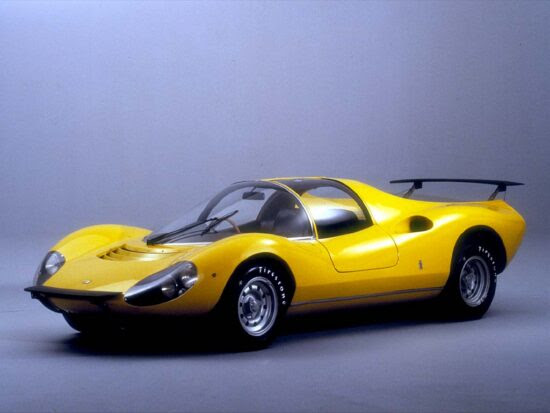
Chassis 020, 034 and 036 went to Ferrari’s then favorite coachbuilder, Pininfarina, for concept car styling. Chassis 034 became the Dino 206 S Pininfarina Competizione shown here. Unveiled at the Frankfurt Motor Show in September 1967, it later was renumbered 10523. Credited with the design was Paolo Martin.
Another of the three, 020, was named the 250P5 and unveiled at the Geneva Motor Show in March 1968. The last of the three was 036. named the Ferrari P6, made its debut at the Turin Motor Show in November 1968.
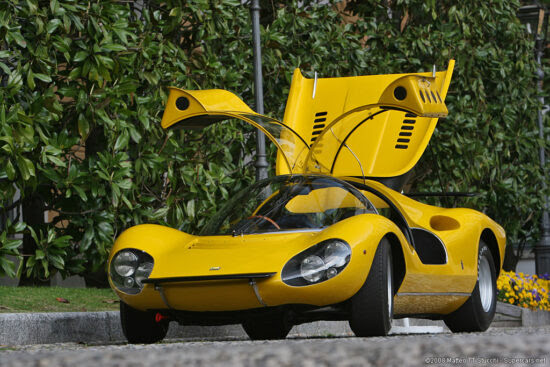
What made the yellow coupe different was gullwinged doors, and a huge rear spoiler on stilts. And it had a short not full width front spoiler on the nose, and the headlights were lower and wider than the lights that eventually graced the production 206GT. Late in its show career it got the flamboyant rear spoiler.
Because it was made for a race car, the Tipo 231 B engine had been used at the Le Mans 24 Hour race in 1966. The all-alloy 65° V6s originally ran dry-sump lubrication, dual overhead camshafts, two valves per cylinder and had a d single plug ignition with one coil. Displacement was 1986 cc. With the standard 10.8:1 compression ratio and a trio of Weber 40 DCN carburetors, peak output was 218 bhp at 9000 rpm. (another source says 175 bhp at 6500 rpm).
Though originally never intended to be run on the street, long after its show debut, it sat at Pininfarina, one customer being persistent , offering not only to buy the car but willing to pay all costs for it to be converted for street use.
Pininfarina finally gave in, so in 2008, it was sold to film producer Jim Glickenhaus. It took a lot of work but it paid off and now that American drives a one-off Ferrari…a car that can be credited as the “daddy” of the production 206GT. It is rare for a concept car to have documented racing credentials but in this case if someone says “That engine sure sounds like a race car,” the owner can start out his answer with “As a matter of fact…”

ABOUT THE AUTHOR/ARTIST: Wallace Wyss (rhymes with "Reese"), the author of 18 automotive books - now a fine artist - depicts postwar sports cars in oil on canvas. Wearing his artist hat, Wallace Wyss says, if art galleries, exotic car stores and car museums want to talk the possibility of taking art on consignment, he can be reached at photojournalistpro2@gmail.com