
Few events in the collector‑car world have generated as much buzz as the Mecum Kissimmee sale of the Bachman Collection. Forty‑six Ferraris, many of them one‑owner, ultra‑low‑mileage unicorns, crossed the block — and the results stunned even seasoned insiders. On a recent episode of the Ferrari Marketplace Podcast, host William Ross sat down with Chris Miele of The Prancing Horse Nashville to unpack what really happened, why the numbers soared, and what most people still misunderstand about the sale.
The Bachman Collection wasn’t just rare — it was singular. Phil Bachman spent decades ordering Ferraris in bold, often bespoke specifications, with a particular love for yellow. Many of his cars were:
- Single‑owner
- Extremely low mileage
- Highly optioned or uniquely personalized
- Documented with factory photos, faxes, and correspondence
- Maintained in pristine, concours‑level condition
As Miele put it, “You’re not going to find another set of Ferraris like this in one place ever again.”
The Enzo That Shocked the World
The headline car was the yellow Enzo — and its final price, nearly $18 million with fees, left the internet scrambling for explanations.
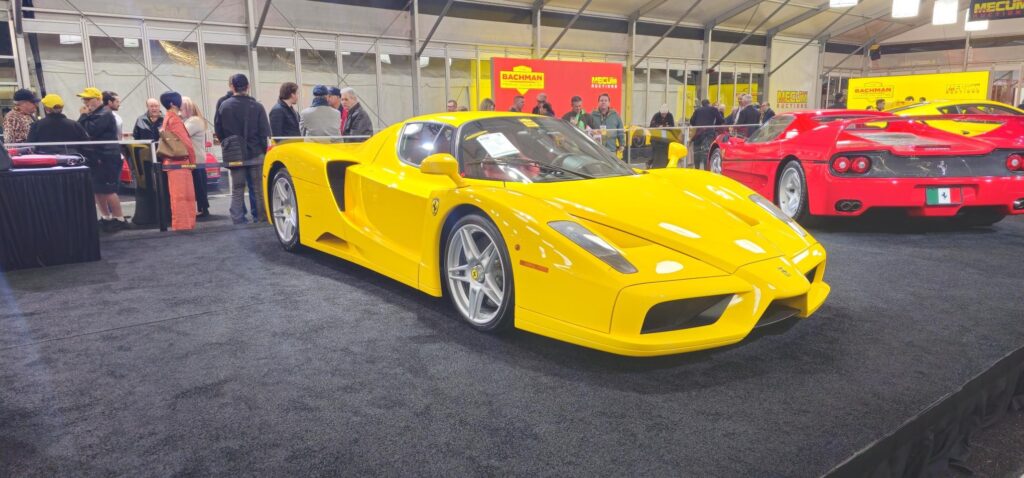
Miele broke down why this Enzo was not just another Enzo:
- One of roughly 11 yellow examples
- Delivered with two sets of factory seats (black and red)
- Unique interior leather split pattern
- Gloss‑finished carbon components
- Polished engine‑bay uprights
- Factory‑painted yellow lower trim
- Enzo Ferrari signature on the decklid
- Single owner, ultra‑low miles
And then there was the bidding dynamic: two determined buyers, both with deep pockets, neither willing to lose. “It became an ego battle,” Miele said. “Once that happens, the car is going to the moon.”
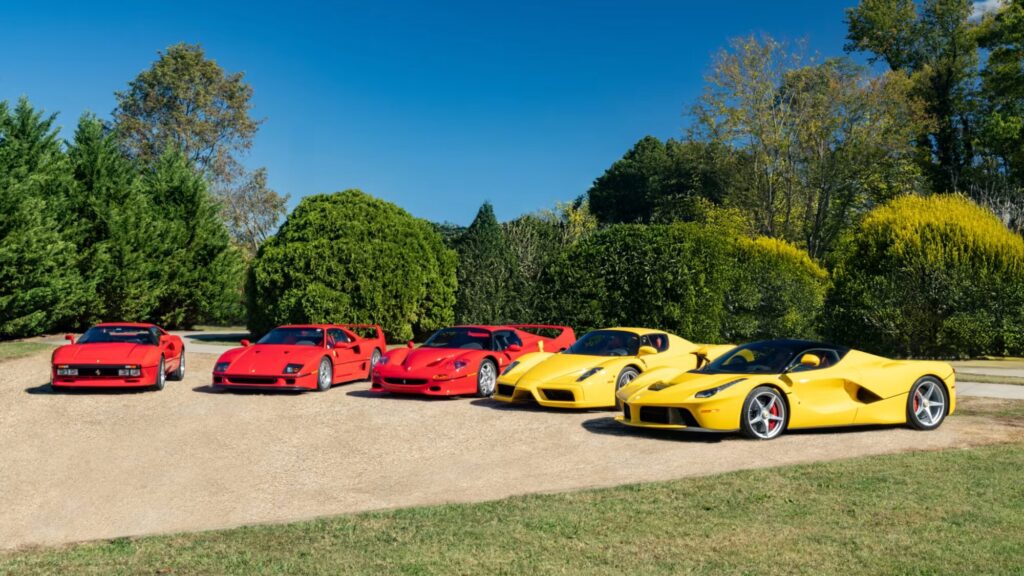
No — It Wasn’t a Charity Sale
One of the biggest misconceptions online was that the cars sold for inflated numbers because proceeds were going to charity. Miele shut that down quickly:
- The cars were sold through Mecum, not the Bachman Foundation.
- Buyers purchased them like any other no‑reserve auction.
- The foundation exists for tax and philanthropic purposes, but it did not receive the hammer prices directly.
A no‑reserve auction also means no shill bidding. As Miele put it: “When the music stops, you better have a seat.”
Why the Prices Made Sense
Miele outlined the hierarchy of value drivers in the Ferrari world:
- The car itself
- Color and specification
- Mileage
- Options and personalization
- Provenance
- Intangibles — first built, last delivered, one‑off features, etc.
The Bachman cars checked nearly every box.
Even seasoned collectors were surprised by how much they liked the cars in person. Under Mecum’s lighting and after meticulous detailing, the colors “popped” in ways photos couldn’t capture.
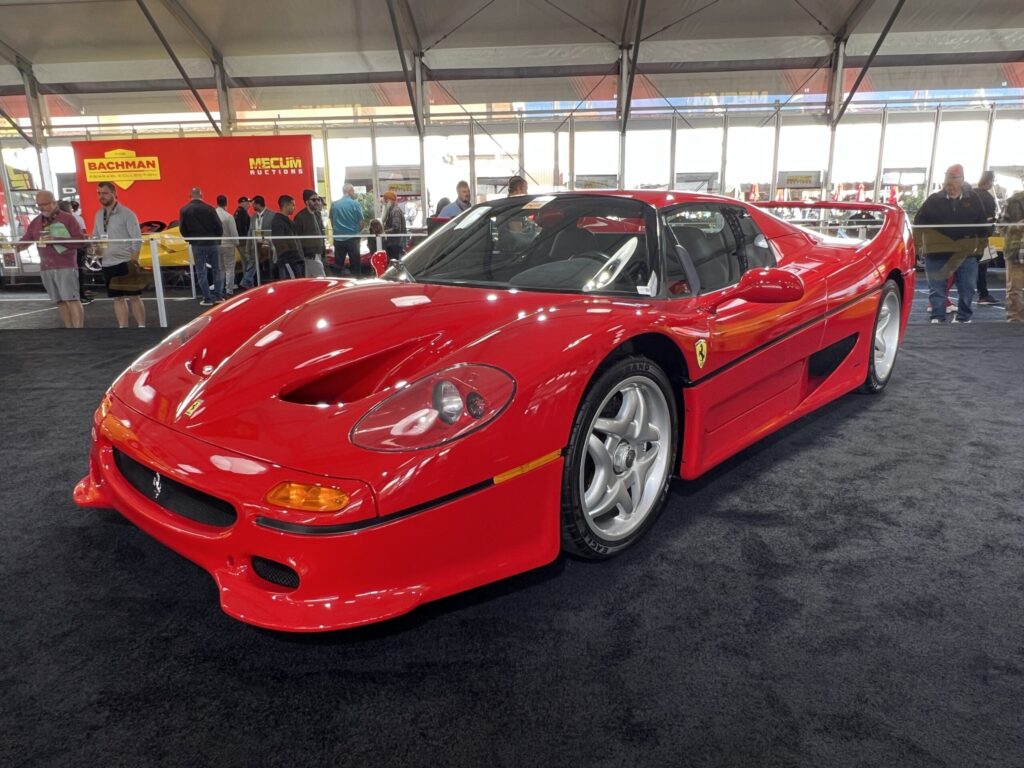
The F50, F40s, and Other Heavy Hitters
The F50 with just 251 miles hammered for a massive number — and Miele wasn’t surprised. “Go find another one,” he said.
The two F40s told an interesting story too. One had a rare dual‑VIN‑plate situation due to Italian homologation rules, making it a true oddity. That uniqueness alone helped push its price far beyond its sibling.
Other standout moments:
- The 166 MM sold for far less than expected — a rare “deal” in the room.
- The 360 Challenge Stradale in Verde stunned bidders and became a breakout star.
- The F12 TDF and 599 Aperta looked even better in person than in photos.
- The FXX at $6M was, in Miele’s view, a bargain.
The Human Side: Stories You Won’t Find in the Catalog
The podcast also revealed personal stories that added depth to the collection:
- Why Bachman Never Bought an F50 New: A factory employee once scolded him for wearing casual clothes during a visit. Offended, he canceled his F50 and 512M orders on the spot — and didn’t buy another new Ferrari for four years.
- The Penske F50: Miele once sold Roger Penske’s F50 for $975,000 in 2009 — a huge number at the time. That same car now lives just down the road from him.
- The 275 GTB/4 Alloy: Miele’s personal favorite. One of roughly 16 alloy cars, restored beautifully, and a highlight of the entire display.
The 250 GTO: A Calm, Rational Result
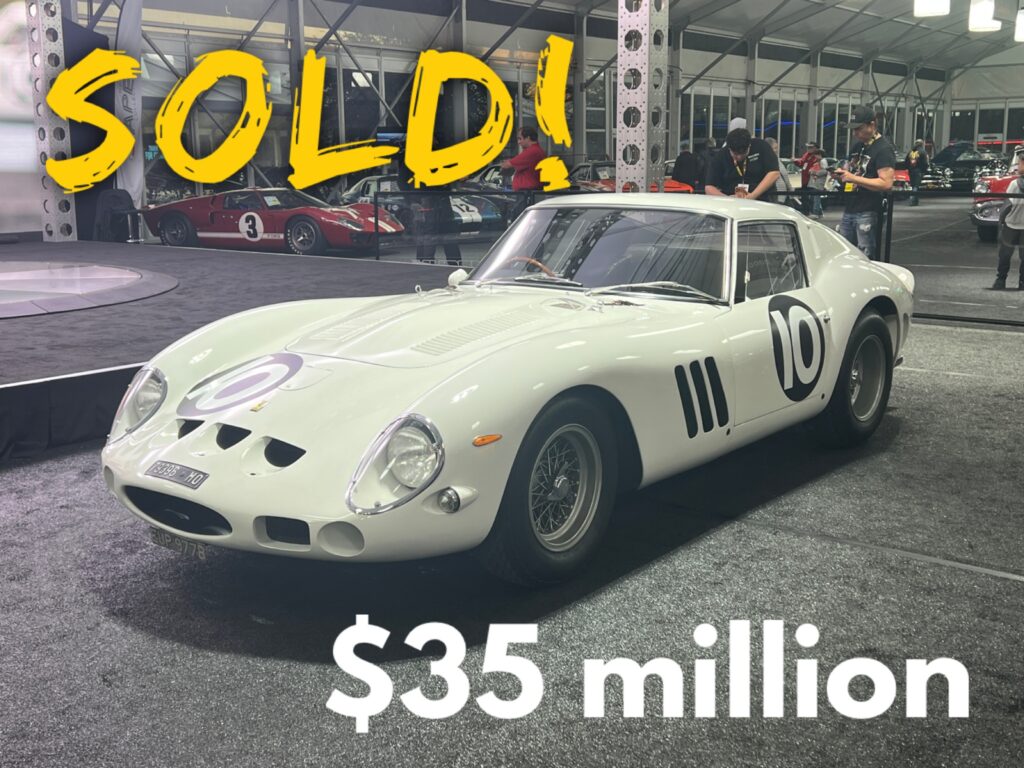
The 250 GTO sale was one of the few moments that didn’t go nuclear. The right‑hand‑drive configuration and non‑original engine kept the price grounded. Still, it landed with a passionate new owner: David Lee, who is known for driving and sharing his cars rather than hiding them away.

Why This Auction Will Be Remembered Forever
Miele has been in the Ferrari world for 30 years. He’s seen everything — or so he thought. “This was the highlight of my career,” he said. “I’ll never see anything like it again.” The combination of:
- A once‑in‑a‑lifetime collection
- Deep documentation
- Pristine presentation
- Global attention
- Serious bidders
- And a perfectly executed auction
…created a moment the collector‑car world will be talking about for decades.

About this Episode
Summary
This episode of the Ferrari Marketplace Podcast features William Ross from Exotic Car Marketplace and his guest Chris Miele, discussing everything Ferrari. Topics range from road cars, racing, owners, auctions, private sales, and trends in the collector market. The episode deeply dives into the Mecum Kissimmee Auction, particularly focusing on the Bachman Collection. Notable highlights include detailed discussions about specific cars like the Enzo and F50, their unique features, provenance, and auction performance. The episode also touches on the detailing and presentation efforts that contributed to the auction’s success, auction dynamics, and high bidder competition. Additional stories include past ownership anecdotes, details about the collector market, and insights into the preparation and execution of the auction.
Highlights
- 00:00 Discussing the Mecum Kissimmee (Bachman Collection) Auction
- 01:33 The Unique Features of the Enzo
- 04:12 Auction Dynamics and High Bids
- 05:32 The F50 and Other Unique Ferraris
- 11:37 Phil Bachman’s Factory Visit
- 14:53 The Bachman Collection’s Provenance
- 17:11 Auction Results and Market Insights
- 25:56 The Mecum Crew and Event Execution
- 28:55 Unexpected Car Enthusiasm
- 29:20 Bidding Wars and Car Collections
- 30:27 Surprising Auction Outcomes;
- 35:32 Detailing and Presentation; and the Bianco Speciale
- 48:01 The Future of Car Events
- 48:31 Closing Remarks and Sponsors
Transcript
Crew Chief Brad: [00:00:00] As part of Ferrari Fridays, William Ross from the Exotic Car Marketplace will be discussing all things Ferrari and interviewing people that live and breathe. The Ferrari brand topics range from road cars to racing drivers to owners, as well as auctions, private sales and trends in the collector market.
William Ross: Welcome to the Ferrari Marketplace Podcast. I have my, uh, good friend here, Mr. Chris Mieley from the Prancing horse in Nashville, who hopefully, maybe we can, uh, coax a little bit more to be on here more consistently because, you know, he’s wealth of information. Today we are going to discuss the Meko Kissy Auction, specifically the Bachman collection.
Maybe touch a little bit on the GTO. Chris was very integral in bringing the collection and the GTO to Mecu to have them cross the block there, and so he knows ’em very well. But there’s some things we wanna kind of clear the air about after the fact as being kind of [00:01:00] thrown out all over the social media and what you wanna call it.
But then also, I got asked a question there a couple times when I was leaving from people asking, well, why so much? Everything like that. Specific reasons why. Honestly, you can see where that was. I don’t wanna say outlier, but it justified it because armed Sotheby’s had their sale out in, uh, Arizona today and some of the cars that were in there, you can see now.
Okay, there we go. That’s where the market should be at. Just that the ones in the Bachman collection, you know, they’re very, very special cars and I, I guess we could jump right outta the gate and start with the end zone.
Chris Miele: Yeah, the Enzo’s a real special car, obviously, because you know, it had so many different special features.
Obviously it was one of the yellow cars and there wasn’t that many yellow cars. Uh, I don’t have to count in front of me right now, but I wanna say it was 11 cars. We did the research on it. I’m just trying to go through 48 cars. In my head, but, but uh, yeah, I mean it was a neat car. Obviously a lot of people, you know, they first saw the car, they saw it with the red seats that were in there with the yellow Daytona stripes, and then they said, [00:02:00] oh, well, you know, I’m not really sure about the inside.
You know, they’ve always made, you know, some sort of analogy about McDonald’s that was always coming up and what was going on with the interior. But Phil had a vision, you know, Phil said, Hey, look, let’s go ahead and let’s do something outside the box. The first color combo that was like, that was on the five 50 Porchetta.
So he started that back in oh one a few years or earlier. He did, you know, on the 3, 5, 5 fiorano he did the yellow and blue. So he either was going at that point, yellow and blue, or yellow and red, and the exterior was obviously yellow was a must, and then he would go ahead and modify. But like on that particular car, on the end zone in particular, you know the uprights in the engine compartment, there’s those two upright supports that go in the engine compartment.
They were both polished. There was. Certain bits inside the engine compartment that are normally just matte carbon. His were glossed over and clear coated and they were polished. You had the Enzo Ferrari signature on the rear deck lid. You had the lowers on the car, meaning the lower trim going all the way around, including the rear diffuser [00:03:00] painted in yellow from the factory.
The car came off the assembly line with the black seats. There’s photos of the car and if you looked at the videos that we made and we, we were running them, there was some photos of Phil working on the car and we had all the additional photos and it shows the car coming off the assembly line with the yellow seats.
But Phil wanted the red ones, so the red ones just weren’t ready. And before he picked up the car, ’cause he went back to go ahead and take delivery of the car in Europe. He went back and then the red seats were installed at the factory. So the car left the factory with the, uh, red seats, but the car came off the assembly line with the black seats.
So the car came with two sets of seats, which was, you know, super unique. The other thing was just the little other stuff that was in there, some of the other pads on the doors and on the passenger side there was a split, so you had the yellow leather. That was the only car I’ve ever seen like that. The only other car I saw that was really, really unique, but it wasn’t obviously on Phil’s, was um.
Jean Tots and Schumacher’s car. You know, there was two or [00:04:00] three cars that had power windows in them, and that obviously was designed just on a couple of the cars, but those car was a super unique car. You didn’t have the power windows, but he had everything else on it. Super low miles. So yeah, that’s why the car is, you know, we always say in the auto industry it did a moonshot and we knew it was gonna go ahead and do a big number, but when you get two guys, they’re going at it and you know the deal.
Once their ego gets behind, you know they’re bidding, then it becomes an ego battle. Either one of them is saying, Hey look, I’m not gonna lose. I know I’m probably overpaying for the car, but I’m not giving up. And you know, it started to run because the car started to stall out somewhere around 12 million, and I was standing up on the block next to Dana.
You know, we’re looking at the board and we’re saying, okay, you know, I think it’s starting to slow down, but the auctioneer did an amazing job.
Crew Chief Brad: Yeah.
Chris Miele: He was still working it and then it started to pick up again. And then it started to really jump. I think they were going by $250,000 bumps and before, you know, it just [00:05:00] started going back and forth, back and forth, back and forth.
And then I look back up and within, it seemed like a minute, we were at 16 million plus. So now I’m like, okay. And you’re looking around and you’re, and, and I’m, I’m on the block and I’m looking around, I’m looking left and looking right, and I’m saying, am I the only one who was like watching, like, it was almost like surreal on that car because it was the highest one outta the whole collection.
Out of all 46 Ferraris, it was car that obviously did the most, and candidly, before that we knew it was gonna be there. We were almost thinking that the F 50 might outpace it after seeing the Ralph Lauren car at Pebble Beach. Yeah, so that car, you know, it was yellow, was one of the two yellow cars, but the flip side was, it had some miles on it, but it was yellow and it had, you know, the provenance of Ralph Lauren that owned the car.
Whereas on this car it was single owner car. You’re saying to yourself, okay, we got a single owner car and it’s super, super unique, and you’re getting ready to see the [00:06:00] car. You know, you, you know, you’re, it’s gonna take off the, the numbers were really, really high. You know, when we came to the F 50, we kind of knew that it was gonna do somewhere in that neighborhood.
Again, it started to go back and forth between two guys. Again, it ran up quite quickly, but 251 miles. Okay, so go find one. The only other one that I knew of, I saw, I sold, when I worked for Roger Penske, I sold Roger Penske’s car, and it’s actually right down the road from here. The ex Penske car is with Dr.
Rick Workman. So he actually has that car. Oh yeah. Mm-hmm. And, and he has some miles on it now, but like, you know, I sold it, I think it had 300 miles. Now it has somewhere around, I wanna say 600 miles. But, you know, we sold that car in 2009, and I wanna say that we sold it for $975,000. And that was a huge number after the collapse of everything that happened.
Yeah. In, uh, late oh eight. So that was really a big number, and it came with all really cool stuff. The letters from Roger [00:07:00] and back and forth with, you know, Montelo. And it just, it had some great, I said the, the provenance. On the car is what drives it. When you look at like the Bachman collection, and when you look at certain other cars, I always say it goes in this order.
I mean, not exactly in this order, but these are the contributing factors that play in. You’re gonna have the car itself, obviously, you’re gonna have color. Mileage options. If the cars, you know, paint a sample or something that’s really unique, which a lot of the Bachman cars were okay, so now you have a unicorn and then you’re gonna look at mileage.
The Bachman cars had like, on the most part, super low mileage. And then you have what I call the intangible. Is it the last one? Was it the first one? Is it the last one that was delivered in the us? Is it one of the very last cars and there’s always people that just run for that. There was a lot of people that said to me, well, why did the F 40, the two F forties, why did the one F 40 do so much more money?
And when the mileage difference between the car was roughly about 400 miles, both 1990 twos, one was [00:08:00] delivered in Italy, one was delivered in the us. Well, the Italian car. To go ahead and get those EE plates that were on that car, you have to go ahead and get what they call in Italy, the COC, and if you get the COC, you have to have an engine plate inside the engine compartment on the frame.
Whereas US cars, we have it in the door jamb. That’s the only F 40 that I know of, and I checked with the guys at the factory and everyone else agreed with me. It was the only one that had two VIN plates. So when have you ever seen two VIN plates in a car? You know, there was people that were doing their inspections and they were like.
Totally flustered about it, you know, but we, we, we knew about it because we did the inspections. You know, we went out there and we did the inspections. It was myself, Emiliano, and Marco. Marco and Emiliano both worked at the Ferrari factory for over 20 years. Both of them, you know, they had either one of them worked on the assembly line for many years, and then they eventually went on in em case Emiliano went to the experimental department.
And then he was involved with Ferrari Classic [00:09:00] K. It was the same thing with Marco. Marco obviously came from the production side, and then he went on the after sales side on the service business, and then eventually made his way back to classic K and was in charge of Ferrari Classic K, and they worked together.
So they knew exactly, you know what to look for. They were, you know, Emiliano was, he was the boss on the assembly line. You know, whether it was the eighth cylinder or the 12th cylinder line. Marco was, you know, similar. They worked their way up. He worked on the 2 88 and Emiliano was in charge of everything else.
When you go through all that stuff, you know, you get a chance to see all that.
William Ross: You know, to your point, first last producer, that there’s gentlemen, individuals, they collect first, last, everything like that. So it fits into their collection. But one owner, I mean, again, find another one. Especially those because like, you know, f fifties Enzos, F forties, I mean there’s always usually a long chain of owners, at least a two or three on those for sure.
But trying to, yeah, and then, so we’re trying to find that single or stuff. I mean, it was very interesting to see. Question though, ’cause [00:10:00] I know you know the gentleman very well. Did Ian have a little bit of seller’s remorse?
Chris Miele: No. You know what’s funny, Ian? You know, we, we arranged a dinner. Ian’s a good friend of mine, so we had a dinner for all the people.
So we had all the Italians, even Luca Zanetti, who was the current president and CEO, Ferrari, north America. He came in, he had to leave. He couldn’t make it to the auction, but it was kind of like a hit and run. He came in and he was there. We had a dinner at Ian’s house and you know, we were all chatting and Ian has quite the collection.
Yeah. La Ferrari. LA Ferrari, APTA 4 58, especiali, apta. He’s got some really, really cool stuff and not a huge collection, you know, talking about, you know, maybe a dozen cars, but. Great stuff. Two 80 HGTO 2 75 gtb. Four four cam. Just great stuff. Ian’s a good, you know, they’re mates, you know Ian and Tom Hartley Jr.
Yeah. And they put together an event every year that they do. And it’s, uh, you know, Zach Brown goes on at all kinds of, guys go on this event that they do. It’s a really cool event because look, at the end of the day, regardless of [00:11:00] what car company you work for, or car guys, right?
William Ross: Yeah, exactly.
Chris Miele: You know, we all love cars and, and, and there’s that camaraderie between all of us.
So it was good. You know, we were all together and I had all the guys there from Ferrari. I had a few other guests that were there, some clients, good friends, what have you. Everybody loved it, you know, it was fun to get everybody primed up. So I said, Ian, are you gonna come to the auction? And Ian’s like, yeah, yeah, I’m gonna be there.
He said, I’m gonna go ahead and bring Joshua’s son. And we went over there and you know, it was awesome. He had another friend of his, with him. It was good, you know, we were all there and Ian sold the car. Funny story about the car. Not everybody knows the story. We kind of talked about it and it’s kind of been brushed over, but the real story is this.
Phil Bachman went to the factory in in 1995, so he went, he was invited to see the car. They showed him the car before they unveiled it in Geneva in 1995. The F 50. He went to the factory. He was coming back to do some configuration. So it was a few months after that. I think Geneva was in March, so it might have been May or June.
It was a little warm out. [00:12:00] Phil showed up. He got there a little early. He used to stay at the Hotel Marella Palace or one of the other hotels that are right there. He was casual, so he showed up in like a shirt and a pair of jeans. You know, normally how you travel on an airplane and normally when you go inside the factory, generally speaking, you know, you show up with slacks on dress, shirt tie, and a jacket.
Times have changed since 1995, you know, 30 plus years. Not everybody’s wearing a tie every day. You know, sometimes it’s the open collar look, but you still have a sport jacket on and you know, you look sharp. And I always joke, you know, Italians get dressed up to go ahead and go get gasoline, you know, or petro or whatever they do.
You know those, they’re dressed up. They’re dressed up for everything.
William Ross: Yeah.
Chris Miele: So he got there and somebody made a little bit of an off-color comment saying, you know, Phil, you should be more conscious of when you come here, you should show up. With a jack and a tie on. And what happened was he stopped, he was at the traffic light, from my understanding with the story outside the factory.
Somebody saw him and said, [00:13:00] Phil, come on in. Have a quick, you know, espresso. Phil said, okay, you know, he was a little tired, obviously. And uh, he parked the car and he just walked across the street. ’cause the hotels, you know, across the street he went in, or, you know, you know, down the road and whatever it is.
I don’t know which hotel he stayed at. But anyway, he goes in. Somebody sees him and they make this comment to him, you know, you should be here and you know you should know better than to do this. Well, he flipped out, he canceled the F 50 and he canceled the F five 12 M. And I think, I think. He, he knew that they were making a replacement car for the F five 12 M, which was the Marine, which if you look at the collection, he never had one.
So Phil canceled those cars. He surely would’ve had car number three of the F 50 in yellow, ’cause there was two that were made for the us. There was Paul Frame’s car, there was Ralph Lauren’s car, and for sure he would’ve had a yellow one. So who knows the way the world would’ve changed. He, he didn’t get a car, so he canceled.
Everything. So it [00:14:00] took Simoni ska years to go ahead and mend the fences. So he didn’t buy any cars until 1999 when he got the 3 5, 5 fiorano. And when we were going through the collection, through the archive, we saw all the faxes. ’cause there was no emails back then of Simoni writing a, of sending a fax to Phil and saying, Phil, I just wanna let you know.
I saw Loris Chea and LO works for Zazi now, and he said, Hey, I saw Lori and they’re gonna be coming out with a limited edition 3, 5 5. It’s gonna be numbered. And he slowly got filled back into the deal and sure enough, bygones are being bygones. But I think Phil dug in and for four years he didn’t get a car.
He went from 95 to 99. He didn’t get a new vehicle, nothing. They came out with some pretty stout cars in there. Yeah. Obviously you had, you had the Marineo, obviously he missed out on the F five 12 M and he missed out on the F 50. So going back to your original question, how he got the car, he wanted a really low mileage car and he knew [00:15:00] that Ian had the car.
From my understanding, the market on the car at that point in time. It’s about 10 years ago. It was about 1.75 million for a perfect car, and we know where it was in 2009. ’cause I sold the Penske car and that was 975,000. So the car was going up still no matter what was going on in the world. Then Ian says in his head, well, I’ll just double it and I’ll go for 3.5.
At the time, Ian had some other stuff going on in his life. He was in the middle of construction on a house, and you know, there was some issues there. And Ian said, look, if I’m gonna free up a car, I’m gonna have to free up a car. Only if this guy gives me some number that’s outta this world. So he doubled it.
And he said 25. And you know, that’s a big number. So I wanna, I wanna bring that up because it’s very important considering what happened in the Bachman collection today. If people say that, okay, a car is worth an, let’s say an enzo’s worth seven, [00:16:00] 8 million. But somebody said, well, I’m not gonna sell the car.
Well, if somebody gave you 16 million, 17 million for the car, would you sell it? Sure, I’d sell it. That’s kind of what happened with the Enzo, because it was a real unique car. You’re not gonna find another one like it. Yeah, and that’s why these numbers did these moonshots, you know, you had a lot of people out there on the internet saying, oh, it was for charity and that’s why it was like that.
I said, absolutely not.
William Ross: Yeah, yeah. Clarify that.
Chris Miele: Yeah, it was a standard auction. The cars were sold through Mecu Auctions. It wasn’t a charity to be a charity. The purchaser has to purchase the cars from the Bachman Foundation. Now they have a foundation. Most people, when you’re gonna go ahead and take in this kind of money, I mean the sale brought in with fees, $125 million.
Of course, they’re gonna send up. They’re gonna sell most times, not always, but they set up a foundation. The Bachman Foundation is, you know, based in the Eastern Tennessee, and they’re gonna do a lot of good things to help different people and different things. You know, they wanna do [00:17:00] some stuff with, you know, some technicians, they wanna build a, I think a school, you know, to help, you know, young mechanics and stuff like this.
So, I mean, you know, they have a bunch of different things in their mission statement, but the point was. It’s a little bit of a tax shelter for them, but the cars were not sold directly from the Bachman Foundation to whoever you know, Mr. John A. Smith who purchased the car, he purchased the car from Mecom Auctions.
It was thrown out there and it was a few people that put it out there, and even people that worked at other auction houses, and I. Quick to go ahead and reach out to them. I said, look, you gotta clarify this, and sure enough, they edited the post or they, you know, we took it down or whatever it was, but it got cleared up very, very quickly because everyone’s like, this is impossible.
Then, then you had, you know, a whole other load of people saying, oh, you know, is it real? You know, one thing about a no reserve auction, you know when you have a reserve auction, it’s real easy to run up. The number on a no reserve auction. Well, you have an internet bid or here or there. Like you really [00:18:00] don’t know because they’re trying to run it up.
But when you have a no reserve auction, it’s like musical chairs. If you go ahead, you better make sure you have a seat when the music stops.
William Ross: Yeah.
Chris Miele: So you can’t go ahead and play that game, especially when you start getting in these high numbers. There was two people on the room now, one of the people that was bidding pretty high up because it takes two to run it up.
So obviously if there’s one guy paying it, regardless of whoever he is, and there’s a lot of people that had comments, well, this guy’s this and his business isn’t real, or whatever the case may be. There was still a guy right behind him running it up. And the guy that was behind him is a authorized Ferrari dealer in North America.
Oh,
William Ross: really? So,
Chris Miele: oh yeah. And, and they were the underbidder on, you know, a bunch of the cars and obviously they had a well to do client. Pretty well known client that wanted these cars. Again, this goes back to the original conversation. When you get a guy that’s a multimillionaire, maybe a billionaire, in this case, I believe he is a billionaire, and he says, look, I don’t wanna know anything.
I [00:19:00] want those cars. And in his mind, he pulls out a number. He says, look, I’m gonna drop 30, 40, 50, 70, whatever the number is, million. I want these cars. He’s willing to do it. He’s saying to himself, where am I ever gonna get a chance again to see all these cars in one place? Yeah. That I can get ’em. And regardless of, you know, whether he super loved the look of them, there was a lot of people that said to me, wow.
I saw these cars in the catalog. I saw ’em in the video and you know, we had all the big bright lights on ’em, and the colors were really exploding when they saw them in real life, they were like, wow, they’re not as vibrant and not as bright as I thought. And you know, a lot of times people looked at ’em and they said, you know, it actually works.
And I thought I wouldn’t like it. There was a lot of that. Yeah. I, I honest to God, there was probably more people. That came up to us and said, I didn’t think I was gonna like this car in person. And it’s really cool. There was a lot of people that said that, you know, it was good. And people said to me, they said, what’s your [00:20:00] favorite car?
And I would turn around and point at the 2 7 5. You know, it was funny, I saw Rick Hendrick the night before and we chatted and I said, look, if you’re gonna buy one car in the collection, that’s the car. And Andy Thomas, he has a 10 10th club, and Andy Thomas works for him. And Andy actually was my rep. At Ferrari North America over 20 years ago, and actually Andy and I were the first two to see the Bachman Enzo when it came into the us and I actually still have the email from 2004 when the car came into the US when it got unloaded.
So look, for us, it was like full circle, Andy we’re, we’re staring at the end zone. I said, Hey, you remember the two of us staring at that car? And then we’re turning our heads and he says, what’s your favorite car? You know, there’s 46 of them there. I said hands down the 2 75.
William Ross: Yeah, I think it was
Chris Miele: stunning.
It was stunning car. Right. So there’s 16 of them, you know. Well, that’s the accepted number. There’s no official number out of the factory because at that point in time, some of the bill sheets, they would mark if it was an alloy, and some of ’em they didn’t. So the cars exist as an alloy, you know, their notes weren’t super, [00:21:00] super detailed at that point.
There was a point. Where their notes weren’t the super best, but you know, when you get into like a build sheet or you start to see the purchase order. If you have the original purchase order, it would show that the car was ordered as an alloy. That car was born as a fly yellow car, and it lived most of its time, uh, with one gentleman, and then it went to another guy, and then to Phil.
Phil had the car restored by, uh, David Cart, who has since passed away during either right, during COVID or right after COVID. He was out of Virginia. And those three cars that we had on the stage, we had the chairs and Flair. 2 46 we had, um, the 2 75 TTB four. And then we had off to the right of that. We had the Luso.
But that car for me, you know, when people ask me what was my favorite car, I said, the 2 75 GTB four Alloy was my favorite car. It’s not even close. And then, you know, when I walked in the other room, I had Dana’s 2 75 Nart. Which was sitting on in the other room. Right. So when you look at that [00:22:00] car, and as much as I love the na, the 2 75 GTB four alloy is, is just my favorite car, John, surely 2 75.
NA is the ultimate rockstar. They made 10 cars, Dan car, the silver one is number nine, and the number two car is John Shirley’s. And I was talking to John talking about the two 50 GTO and I saw John and we were chatting. That car lived legitimately a quarter mile from my high school for many, many, many, many years in New Jersey.
And I used to see the car driving around all the time. And then as time goes on, the internet builds and you start doing your Google and you start looking things up. You say to yourself, man, I wonder what happened to that car. Sure enough, John surely has it. So when we, when we went up there to go see John and Dana and myself, we went to go put together the deal for the two 50 GTO.
I saw the car. Now we’re there to look at a two 50 GTO. I’m all over the narc [00:23:00] because me growing up, I’m like, Hey, this is the car I used to see all the time. So it’s funny because you know, you see a car and you identify something about it, whether it was Oh,
William Ross: triggers
Chris Miele: trigger something. Right. And see, and, and for me, the other car that does that is the 3 0 8.
So for me, the 3 0 8 triggers at big time, growing up watching Magnum pi, I remember watching it. Yeah. You know, and it was like, uh, for whatever night, it was like Thursday night, you know, Magnum PI would go on and it was a weekly show. And then for me, fast forward. I joined the Marines when I’m 17. I get stationed in Hawaii, you know, I know where the Higgins, you know Robin?
Rob, Robin Masters. The state is, you know, it’s in Wyman. Fast forward and I’m the general manager of the store in Hawaii. So when they did the new version of Magna Pi, I would see the Ferrari, you know, with the Robin one plate. You know, we were doing the service on the cars that they used for the show. So it’s so funny for me, like full circle, you know, for that, that car.
And then, you know, the [00:24:00] last but not least car for me was, was the 2 8 8 GTO. Because I, you know, I mentioned to you on the earlier podcast growing up, I grew up with a family that was really involved with Benjamin Moore paint and they, uh, they went to the Ferrari Club Nationals every year and they, they had Ferraris.
We would go to the national and we would show the cars. And this was going all the way back in the 1980s. And I remember going to Watkins Glen in 1984, and they had the first, maybe it was 85, but I think, I mean maybe it was 85, it might have been 1985. I forget what year it was, but they had the RY Club National at the Glen.
We were, you know, watching the two eight A GTO that was there, and they had the first tester in the United States come. And that was a big deal for the tester because remember. The BB five two and the BB five 12 I, that car was never, you know, homologated for the United States. Yeah, they were federalized.
William Ross: Yeah.
Chris Miele: Right. The cars that came in were the old quote unquote gray market cars. And you know, you would see them and then it wasn’t like today where you could say, [00:25:00] listen, let’s look on the internet and see what the differences are. The car would show up and we were like, okay, it has a body color bottom, but the other ones have a black bottom.
Right. So you know, that was an option that came out on the real later bbs. So it was like all that different stuff and you would see it in the Bachman collection. So when we were looking at the Bachman collection, like I can identify with every car, like I could see the difference between a BB 512. I could see the difference with a BB 512, I, you know, whatever the car was, I can quickly look and they say, well, the cars are the same.
I said, no, they’re not the same. They’re like, oh, the interior’s different. I’m like, no, they’re two different cars. This one was delivered to a German market. Look at the grill, look at the lights, you know, behind the grill. Yeah. Market lights and, and Right. And then people would look and they say, oh my God, I didn’t even notice that.
It was just a question of, you know, really educating people and, and, uh, and listen, I had a blast. Like I, we had such a great time during the week doing everything. It was really, really, really just an awesome week. I, I can’t tell you how much fun we had and honestly, hats off to [00:26:00] the Mecu crew. They were amazing.
Brett, Dana, Dan, Brianne. I mean, look, the list just goes on and on and on. Like everybody there was there to help you. Just, you name it. Mike, uh, Harold. I mean, look, it just keeps going on and on and on. Everywhere I went to, they were just such an accommodating team. Even Dominic, the guy that runs the golf carts, you know, Hey, we need to grab somebody.
Hey, we, we need to do this. Hey, we gotta grab this guy. I mean, like everybody, like, they were just awesome. Just an amazing team. And to do everything that they did from the beginning of October to have it to the market in 90 days, it was unheard of. Yeah, I’ve never seen anything like that. The presentation was just over the top.
Yeah, it, it just, yeah, they nailed it. I can’t, they nailed it. It just killed it. I mean, it was like nothing else I’ve ever seen recreating the garage upstairs. We had that little loft up on top. Yeah, I
William Ross: saw it.
Chris Miele: Yeah. And you know, we brought people up there and they would, and they would go through the archive and they’d say, Hey.
And you know, the thing that, that we, including Marco, myself [00:27:00] and Emiliano, we would see people and they’d be going through like multiple, multiple, multiple cars. And it was a little, probably a little strange to us. ’cause we would say to them, Hey fellas, how are you? Good, good, good guys need help with anything?
Like, nah, I’m good. You know, it was, you know, and you could see the big screens playing and it has me, Emiliano, and Marco. Like, if you watched a video, you could easily say. Wait a second. They’re the guys that are in the video, they’re talking about this. Maybe they know something that I don’t know. Yeah, they might
William Ross: know a
Chris Miele: little
William Ross: something
Chris Miele: and we, you know, and we, they would look at me and, you know, the typical Italian phrase, there’s no words talk, but they go like this, you know, they do this and, and, and we were laughing and I’d say.
I don’t know what to tell you. You know, we would talk to people, say, Hey fellas, you need any help on anything, let us know. You know, everybody doesn’t want to, to show their hand or whether no, you know, they’re, they’re in the middle of looking at something. Maybe they don’t want you to know who they’re looking for or whatever the case is.
But you know, we were like, Hey, listen, you know, we’re here to help if you have any questions, if you wanna go through the car. And then it was the opposite on the other side. You [00:28:00] had people show up and say, Hey, listen. I watched the videos online. I’ve been watching the stuff on YouTube. I love the video.
Can you walk me through this car? Absolutely. And we would spend as much time as we needed. There was, there was people that we got there. There was one gentleman, he got there at 10:00 AM He left at four. Wow. And I was with him for six hours and I went through every single car. He took notes. I know for sure that he bit on a lot of cars.
I’m not quite sure if he won anything, but I know he was in the race. Towards the end on a few of the cars. So look, it was enjoyable because again, it goes back to the beginning of the question, why did the cars do all these numbers? Yeah. ’cause we took that time, we educated some people, they saw the value in the car.
’cause there was people that even looked at the catalog and they’d say, you know, I went through it and it says, Hey, this is the last one for the us or this is the, you know, there was this many made in yellow or with this color combination. It’s one of X amount. Yeah. Let me go ahead and run it through you.
Let me show you something on it. And then they would look at the car and they might even be on that car. Look at the car next to it and say, [00:29:00] I looked at this car and I didn’t really think I’d like it, but you know, this is a really cool car. It it, it was kind of cool, like, you know, when I spoke to Tom Cabio, you know, from Garage 26, they got a great Instagram page and they’re down in Miami.
Yeah,
William Ross: I’ve been in his collection. That’s
Chris Miele: unbelievable. Yeah. So he, he picked up a few cars, right? So he wound up at about four cars. You know, we were going through it and, and I knew the other guy, the guy outta Connecticut that was running against them, right, on those cars. So everybody thought that it was the same guys that were bidding on the same cars, which wasn’t the case.
There was multiple, multiple people. And then on the big cars, there was a group of guys. Then there was like, on the other stuff, like I said, like the three 40 eights. The three 20 eights they were trying to fill in. Then it was the vintage guys. You know guys that were chasing the Luso and the chairs and flares car.
Then there was guys that were chasing just the bbs. There was a bunch of guys that just came in on the bbs. Then there was the guys that were saying, Hey, I already have a 2 8 8 GTO, but I want one [00:30:00] that’s like pristine.
William Ross: Yeah,
Chris Miele: so, so now one owner that
William Ross: mileage. Yeah,
Chris Miele: so now they’re hoping, there was guys that had the car that were cheering that the car would keep going up because again, look, they have the car they may have bought in, who knows when.
It could have been 10 years ago, it could have been 20 years ago. But there was people that bought in obviously considerably less and they were like, oh heck yeah. It’s like go higher saying Hey, this is great because now how their this thing go. When, when people said to me at the very end, is there any cars that.
I thought did less than what they were gonna do. And I said, yeah, there was one car in particular, the 1 6 6 mm. That car Yeah. That surprised me that, that somebody, somebody got a killer deal on that car because they paid, I think all in around 2 million bucks and it should have did. At least a million more.
And I, you know, I chatted with Brian Ross about it and Brian’s got an amazing collection and uh, you know, he’s a Ferrari dealer up in Vancouver. And look, we’re all friends, you know, we’re all friends with each other. We were really, really surprised. Even [00:31:00] Emiliano and Marco, we thought that the car was gonna do closer to 3 million or somewhere like up in that range, for sure.
Again, there was people that expressed interest and I don’t know if something was going on in their life or they just didn’t get on the phone because there was people who did register. They got pre-authorized? Pre-approved? Yeah. You know, with their letters and didn’t bid, and then there was people, wow.
Who got there. They looked at the cars and then maybe they walked around and they said, Hey, you know what? I really love this. 5, 9, 9 Seperta. I, I love the car, but this color combo, the yellow and green, nah, it’s just not me, but there’s another one for sale in the auction. So Dana had over 125 Ferrari in the sale.
William Ross: Yeah. He had a, yeah. That was outstanding what they had outside of the Bachman collection as well. I mean, there was some blue chip stuff in there.
Chris Miele: Oh my god. Yeah. And then, you know, like the other Enzo, the, the RiNo car that came from Gerald Barnes. Yeah.
William Ross: Strong.
Chris Miele: So that car, that was another car Dana and I worked on together.
Dana and I were. Chatting on the phone every single day. And that went back to, I don’t know, [00:32:00] either, I wanna say October or November. We were chatting about that. And Dana, in November I think it was, you know, we were trying to lock that thing up and Dana was saying to me, he said, Hey, you know, there’s multiple cars in the package and we were chatting what we thought they were gonna do, and it was a paint.
The sample nine 18, that was part of the package that Rick Hendrick got that car.
William Ross: Yeah.
Chris Miele: Again, the same players that were involved on the cars on Saturday, that car ran on Friday, the nine 18 fighter. It was the same guys that were in the same mix, but you know when they lose the day before, you know, they sleep on it and then they wake up and they say.
I’m not losing on that Enzo. I don’t care what it takes. So when you get a guy like that and his ego gets behind his, you know, behind the thought, now you’re like, okay, listen, this is really gonna be, this is gonna be a horse race. Now this is really gonna go at it. And sure enough, that’s what happened. But you know, case in point.
People say, oh, it was just the Bachman cars, or whatever the case is. I say, okay, well then explain to me why the RiNo Enzo did the number it did. Because [00:33:00] listen, if that car was regular red Rosa Corsa, it does millions less because Oh yeah, it’s a more common car. Once you get into rare shades. It’s one of 2, 3, 1, whatever the case may be.
That’s it. It’s game on at that point.
William Ross: Yeah, and it’s great to see that too. It just, it just validates, you know, especially doing, you know, you got your personalization and everything like that and yeah, some stuff might come out, might not be someone’s taste, but it is someone’s taste and just makes it that much more special as it compared to all the other ones.
For sure. You know, especially if someone goes to the FCA meets stuff like that. They take that, they’re not gonna be lined up like one, one after another to all the same color or anything like that. It’s like, nope. We know who that is. We know where it came from. You know, just, it stands out. It makes it that much more special, which is great to see.
You know, you take pride in that. We Did you take
Chris Miele: pride? Absolutely. We did a car, I don’t know, I guess it was right around this time we were chatting and there was an F 12 and a 4 88 spider that were both done without paint. So if you remember the Mercury pilots. You know they’re Mercury [00:34:00] astronauts. Yeah.
They had all aluminum, no paint Cobras, and then quickly Rathman Chevrolet, which isn’t far from here. It was right down the road on the Space Coast. The, a lot of the astronauts at that time had Corvettes and they had some deal hooked up with Rathman and Jim Rathman won the Indianapolis 500 back in the fifties and he had a Chevrolet dealership.
So I, I saw an article and I was flipping through a magazine and I saw an all aluminum Oprah from one of the astronauts. Then fast forward. I knew that there was an F 12 TDF that was done in the states that had no pain on it, and then there was obviously a a 4 8 8 spider that was done the same way. So sure enough, we did the same thing with an A 12 competency, ONA.
My one client had it, we built it and he kept the car for a couple years. It was sitting at the dealership and another collector. Another gentleman that out of the New York area, originally he saw the car and uh, he’s like, I gotta have that car. And at the time it was a world record and people are like, oh, you’re nuts this, that, you [00:35:00] know, you’re paying crazy money.
Well, here it is further down the road, you know, not quite a year later, the car probably went up 750,000 more than what he paid. And he paid like a world record.
William Ross: Yeah.
Chris Miele: For that car already. So his a 12 competition is worth tons of money, and it’s an exact same mirror image of what happened in the Bachman collection.
The Bachman collection, when you looked at that F 12 TDF. Okay. That was one of the cars that people saw in person. They said, wow, it’s not as wild as I thought it would be. Again, when you look at a car like that, and then, you know, we put so much time into detailing, you know, we brought in a gentleman named Squeaky, Pete.
Pete Wedge, he’s outta Miami area, really well known detailer. He brought his team, his brother Sam, and a few of the boys down. They all showed up there, and I’m telling you right now, they camped out and we had those cars looking like glass.
William Ross: Oh yeah.
Chris Miele: I mean, they, they were like glass. I mean, we, we made, we really, really worked on ’em as if we were doing concor restorations.
And listen, he could have spent even more time on each car [00:36:00] and really made them look like legitimate like glass. But. They looked unbelievable and people were coming in and they said, man, I’ve never seen cars puff like that. And Dana’s guys had the light pop in the right way. You know when the cars went on stage, if you just watch those videos and Dana ran through 4,000 plus cars, there’s no cars that look better.
Shine wise, there’s cars, you’re right, there’s cars that look, there’s cars that looked really, really close when you looked at the Yanko collection and some other cars. Those cars were spot on too, but when they went up on that stage, especially like the older cars, the 2 75, and the Luso with the bani wheels and the chrome bumpers, when those cars hit the stage, I.
They looked electric. Like I was just sitting up on the stage and there was a bunch of canid shots that people sent to me, of me looking, and I’m up there and I, and I’m leaning over. I saw, saw, I saw on the top of the block and I’m smiling and I’m like, yeah. They said, these cars look like movie stars.
Like it just. Yeah, they just looked so perfect and that’s why they brought the money. So I tell people it wasn’t just one [00:37:00] thing or one bidder. That helps obviously, but there was so much the road to the sale that got those cars to bring it there. The storyline that we did, the videos, the whole Mecu team getting the catalogs made the way they did the catalog was absolutely amazing.
The data that was in there, you know, the online presence, you know, MECU doing it, us doing it, you know, the dealership doing it. Just everything, you know, and, and we, everybody did their part. And then it was like, okay, when are we gonna get a chance to find another car like this? And believe me, a lot of people sat back and said, I’ve been in this business a long time, I’ve never seen anything like this in my entire life of just Ferraris that are this cool, this eclectic, or whatever the case may have been in this condition.
With this mileage single owner? Um, on a lot of the cases, yeah. Not obviously. Obviously, the ones that, it was unbelievable. I
William Ross: won’t see it again. It probably won’t
Chris Miele: see, see it again, won’t, and listen, I’ve been doing 30 years, never saw it ever happen. So for me it was really, really special to be part of it.
And obviously, [00:38:00] you know, develop a, a relationship friendship with you and a lot of other people. It was just, honestly, when I look back, if I look back and I say, okay, look, you’re gonna do your testimonial on your career and say, you know, what was like the highlight for sure that’s gonna be up there. Oh, absolutely.
It was right there.
William Ross: That definitely up there. There’s two also I wanna touch on because I, I absolutely love them. The yellow one brought no good strong money, but the green one that really opened up eyes in those, the 2 360 Challenge Rad.
Chris Miele: Oh my God. Yeah. So the 360 Challenge rad people would look at the first one, he went all out.
So it was like, you know when we looked at like the 5 9 9 SA perata and we looked at the 5 9 9 GTO and even. The 360 Challenge Rad. The yellow one. It was almost like if you said, okay, look, here’s an option list and these are all the little things we can do. It was almost like when you see that one, it’s like select all that’s, you know, it’s like, okay, but they didn’t, they didn’t have that back then.
Right. So it was almost like select all and that’s when you know, you [00:39:00] know, you would look and you would say, okay, he did every single thing, like the headlight buckets on the 360 challenge tri, all the little detail work. And you saw the same thing in the 16 s, but the green challenge triology. Yeah.
William Ross: God, that was gorgeous.
Chris Miele: Was That was another one of my favorites. So
William Ross: yeah,
Chris Miele: that was in my top five. So when I would look at that car and I said to myself. Oh my God. I said, this car is just an absolute rockstar. You know, when you saw it all polished up, people were going crazy for that car. And that car did, I’m Monster. Monster number.
Yeah, monster number. Was
William Ross: that only Chara in Green that produced or is there any other
Chris Miele: No, I, I think there was two in green, but I’m not sure. Sure if there was another one in that exact shade. ’cause there was 1300 cars that were produced. But I gotta get the catalog. It’s, you know, it’s funny, I went through the catalog and I knew the thing inside and out when we were producing the catalog.
’cause we were constantly going back and editing and, you know, let’s double check this. So, you know, this one has a plastic case certification, this one doesn’t. But on that particular car, the seats [00:40:00] that were in the car came with that car came with two sets of seats as well. So the original seats in there.
The red in them with the red seats, although they’re very, very cool. It had a little bit of that Christmas tree look, you know you had green car with the red seats. Yeah. You know, and then Phil got another set of seats and he ordered another set of seats and he went ahead and he continued on what he wanted to do as far as the green that was in there.
And candidly it looked great. And look, it was colors that were offered at the time. You had to go ahead and do an extra comp area request. But they were alcantara colors that were available at the time. Ferrari at that point in time. That’s really when they were switching over from the original RIA TI program, and then they were moving into what they called atelier.
Atelier became tailor made, and then it started to build more and more and more. As time went on, you would actually see, you know, how they evolved and you know, a lot of the other brands started to do it. Bentley [00:41:00] was probably, you know, I always talk about it. Bentley was probably like the originators of this program.
Their Moller program and their Moller division is unbelievable. And then, you know, you had Rolls Royce doing it, you know, with their Beast Folk program and you saw all the top companies in the world. Starting to do it. And you know, as time went on, people would start to do the customization and it’s a huge, huge, huge, huge business now for Ferrari.
Massive, massive. It’s massive, massive, massive, massive. And you know, I tell people you would see Dreamlines on Phil’s cars. Dreamlines are like pretty common now on cars. But Phil was like the originator. You had dream lines on the wheels. Even their FXX, which who customizes a race car. It was the only one that was originally produced in yellow.
There’s been a few guys that when they did the EVO upgrade or they sent the cars back, now that they’ve upgraded, I think there’s three yellow ones that are out there flowing around, but two or three. But Phil’s is the only original one. And that also was a car that was a deal. ’cause I thought at $6 million.
William Ross: Yeah, I did too.
Chris Miele: [00:42:00] Yeah, that, that, that was a good deal for that car. I’m not sure who got the car. You know, I, I haven’t gone through the whole list to see who the purchasers were, but I’m happy for everybody who got ’em. And there’s been people who have reached out to me at the dealership and have said, Hey man, I know that you were up there and I saw you quickly and I didn’t get a chance to chat with you, but I knew, obviously I had the catalog and it’s says Prancing horse in Nashville.
And you know, I just wanted to chat with you about the car and I was on the phone with a gentleman yesterday. He bought actually the F 40. I was telling him some stuff and he was like, floored. He’s like, oh, you’re kidding me? I said, no, and I said, I said, when did you see the, I said, when did you see the, the collection?
He said, you know what? He said, I saw the collection years ago. I met Phil and Martha Bachman years ago. I knew who they were and I knew how well they took care of the cars, and there was a lot of that too. There was people who knew the bachmans or competed against them at an FCA event or at Caino or whatever it was.
More times than not, they lost out to them, you know, that their cars were always super pristine. They said, you know what? We lost out to [00:43:00] them, but now’s my chance to get in. I always said, Hey, if that car ever comes for sale, I wanna make a run at it. And you know, we, we had calls, it was nonstop. Dana had calls, we had calls at the dealership, Hey, I really wanna buy that car.
Okay, but I want you to pull it out of the collection. Oh, okay, no problem. What do you wanna offer? Yeah. And they would say to me, I’m gonna make a bid. That’s, you know, like an astronomical number. Okay. What are you gonna bid? And they would say, I’m gonna go ahead and bid. Let’s say like on the Enzo, I’m gonna bid $8 million.
We knew that it was definitely gonna do more than that. ’cause you know, we were chatting with a lot of people and I’d say, now you’re a little short bud. And I’d say, okay, nine. And I’d say, no, no, no.
William Ross: It was
Chris Miele: short, buddy. I’d say the first, the first number starts with a one. I said we already, we already had people beforehand that were saying, look, I think the car is gonna do 10 to 12 million.
And then. You had people for us to pull a car outta the cell, or at least we couldn’t. We’d have to approach the family and the foundation for us to pull a car. It would have [00:44:00] to be some crazy number. And he said, well, what’s crazy? And I said, north of 15, the guy’s exact words were, you’re dreaming the Carl.
I’ll never do that. I said, well look, guess what we’re gonna have to see. Or did 17 and change? Yeah. Changed almost 18 million. Yeah. So, and, and again, this is even me saying it, if you would’ve told me that the car was gonna do that number, I would’ve been just like that same guy. I would’ve said, you’re crazy car’s never gonna do that number.
But it did it, and it took two people to go at it to get to that number.
William Ross: Yeah, everyone was prior to it, you know, 10, 12. Yeah, I like that. Which I was like, yeah, that’s maybe a little bit more, but hey, it takes two to tango and they start jacking that down and going, which options? See? ’cause I mean, the excitement in the room was phenomenal.
It was just fantastic to see.
Chris Miele: It was, it was
William Ross: unbelievable.
Chris Miele: It honestly was, it really was unbelievable.
William Ross: Real quick on the two 50 GTO. I thought it went right where it should have been. It was fantastic. But the one cool thing was is David Lee is the, uh, new owner of that, which is fantastic ’cause and he loves to exercise and show his cars like that.
So I think that [00:45:00] ownership, how he goes about it, the same as John did showcase it with people, shared it and everything like that. So I think it was awesome to see that he was, ended up with it.
Chris Miele: For sure. And David, you know, it’s funny, you know, ’cause when you look at David’s collection, it’s red and yellow, right?
So I, I said, well the car’s already been yellow. Let’s just hope, I mean, it’s already been red. Let’s hope that he doesn’t make it yellow.
William Ross: Yeah. But it was,
Chris Miele: uh, you know, it, it was really a lot of fun and you know, it, you know, it was going back and forth and you saw the famous photo of Dana with the hats down sideways.
Yep. You know, when he’s negotiating with, with Kevin, who was the broker that was helping him in the sale. So, you know, you could see, um, you know, they were trying to get it over the finish line, and it was one of those deals that, you know, when people say to me like, what do you feel about the number? I said, I thought it was a little light, but not by like a crazy number because look, it was a right hand drive car.
If we were in a right hand drive country, it probably would’ve helped considerably. But in our case, you know, a lot of people, you know, it’s like throwing a baseball. If you’re, I’m, you know, I’m, I’m, I’m truly ambidextrous, [00:46:00] you know, I’m, I do things left-handed and right-handed. For people who aren’t that way.
If you get in a car and when they try to shift, it’s almost like trying to throw a baseball. It’s almost like,
William Ross: oh, that’s so awkward.
Chris Miele: It’s, yeah, it’s very awkward. Right? So I’ve been with people who, and they’re like, I can’t do that. I just can’t imagine doing it. So mentally they get themselves out of it.
Like right off the bat they’re like, yeah, I don’t think I can do that. The flip side to that is the engine wasn’t original. But then again, you know, look, a lot of engines weren’t original on a lot of cars. Even some of the two 50 GTOs have had some pretty, you know, rough stories. Them, I mean, there’s cars that have been in accidents.
Drivers were even killed in know, killed
William Ross: them. Yep.
Chris Miele: One or two of the cars. Right. So yeah, there was far that, but the car had a great story, obviously with John Coombs and how it had the vents on the hood. The car came out of the factor, like the rest of them with the two vents on the side. And then after they, the car had an accident and then there was some sheet metal work done and they added the third vent on the side and the vents on the hood.
And you know, the car was mainly raced only in the [00:47:00] uk so it didn’t do the, you know, international tour. It didn’t go to Lamont. Target. Flo and what have you. Didn’t do any of that. The car really was limited to, you know, it did a lot of racing at the time in Goodwood. But you know, it had an interesting story about, you know, Jaguar reverse engineering the car and, you know, they loved it and it helped them develop the e type further.
It was a great car, you know, I mean, it just, yeah, it had a great story. John was amazing with it. John took the car and John used the car for, um, 25 plus years. He bought the car in 1999. He had a, you know, he took it everywhere. I mean, whether it was in the uk, the car was on these tours in Italy. He had car tours that he did in Europe.
He took the cars and he raced it at Laguna and different track events in North America took the car to Pebble, you name it. Yeah. So I think, I think David, to your point, is gonna do similar.
William Ross: And continue a long ownership history, not just, you know, a couple years move it on, he’ll be another one that’s gonna keep it 10, 15, 20 years.
So that, that’s what’s awesome to see about that as well. So, you know. [00:48:00] Absolutely. That’s good stuff. But hey, I appreciate you coming on. Yeah, we’re gonna definitely get you on a lot more and we’re gonna do some other fun stuff somewhere down the road. We gotta start doing some more things together, so.
Right. No,
Chris Miele: I appreciate it. It’s been fun. I appreciate it
William Ross: and
Chris Miele: I’m
William Ross: looking
Chris Miele: forward to the next one. Yeah,
William Ross: state travels through, uh, retro mobile and uh, going over to the uk That’s gonna be a lot of fun there as well. So enjoy your time and again, appreciate it and see you next time.
Chris Miele: Alright bud. Look forward to it.
See you guys soon. Take care.
PROMO: For everything from Ferrari and Porsche, Lamborghini and Konig seg, visit exotic car marketplace.com. If you’re into anything with wheels and a motor, log onto the Motoring Podcast network and check out our family of podcasts@motoringpodcast.net. This is the place to find your favorite new show. Next up a shout out to David Beatie and his team at Slot Mods who custom build some of the coolest slot car tracks in the world@slotmods.com.
Let your imagination run wild. [00:49:00] And finally, grand touring motorsport covering all aspects of auto racing and motorsports history. Check out their ezine@gtmotorsports.org. All the links for our sponsors are in the description.
Crew Chief Brad: We always have a blast chatting with our guests about all sorts of different topics, but sometimes we go off the rails and dig deeper into their automotive and motor sports pasts as a bonus. Let’s go behind the scenes with this pit stop mini for some extra content that didn’t quite fit in the main episode.
Sit back, enjoy and remember to like, subscribe and support break fix on Patreon.
Chris Miele: But I, you know what? It, it was awesome and I’m, and I’m happy. To continue these on and, and talk more about more cars and more things. I mean it’s really, it’s been super, super fun to do all this stuff. It was great.
William Ross: I know you gotta get going ’cause I know you still got a pack and I see your wife walk around the background.
She’s probably [00:50:00] eyeballing you.
Chris Miele: You know, the last 12 months have been great. Dana just actually was calling and um, I said, Hey, I’m jumping on this podcast. So I said I gotta ring you back. But you know, we gotta catch up on. Everything that’s been going on, because the last couple days I flew back up to Nashville to get some stuff at the store done.
And now we’re, we’re, we’re, I’m on my way to retro, so I’m gonna stop in, in, uh, London and, you know, just do a pit stop, like I said, at, you know, at Red Bull. And obviously to stop at McLaren. ’cause uh, you know, we have a client, I have a client with me who is, um, you know, a client of both of them. So I said, okay, well, yeah.
We’ll do a pit stop while we’re on, going on over and then off to Paris on Wednesday. And then Wednesday, Thursday, Friday, Saturday, they got an RM auction that’s over there. So that’s on Wednesday. And then, uh, before you know it, you’re on a plane, you’re coming back and, you know, getting ready for the next event, which is, uh, caino in palm.
It’s just like a blur, you know? I mean, last year I did something like 150 flights [00:51:00] total for the year or so.
William Ross: It’s good age for Caino. Being at the Boca now, I mean, I’m,
Chris Miele: yeah, and I think it’s gonna be good. Yeah. Yeah. It’s gonna be good. I think, I think it’s better that, you know, when you looked at the lawn at, at the Breakers, you know, you’re always limited to that one green that was right out front.
So they, they were smart about it. They have a lot more space at Boca Raton, but I think they’re still limited. They’re somewhere around 175 cars, give or take, and they could have obviously went. Probably double that they got enough space to do it, but they’re smart because, you know, you still wanna keep it, I don’t wanna say intimate like it is in, um, you know, when you look at the event that’s in Modina, or if you look at the one that’s in the Middle East, it’s a great event, but it is, the field is definitely somewhat limited.
Whereas in the US that’s the original event. It started obviously at the Breakers, you know. You know, many, many years ago, and it’s been, you know, an amazing event over the years, but now when you look at it, it’s different. You know, it, it was, it was such an intimate event for many, many years. And now when I look at it, I, I, you know, I don’t wanna say it’s [00:52:00] got like that Las Vegas feel, but it’s got a lot of the glitz and glamor and, and candidly, I went to the Las Vegas Concord this year.
That’s one the up
William Ross: quick.
Chris Miele: Yeah. And I really, really feel it’s got that Las Vegas pizazz behind it. Anywhere you book, you know, you go to Palm Beach, you know, and you know, I haven’t been to Boca for an event. I’ve been to the Boca Raton. But you know, you go and you wanna go out to dinner, the restaurants at the hotel where like, you know, maxed out.
If, unless you made reservations way in advance, sort of like pebble, you know, you go and you’re saying, Hey, what do you guys feel like eating tonight? They’re like, Hey, let’s go for fish. Okay, let’s call a couple. No, we’re totally sold out. Nope, we’re totally sold out. Whereas in Vegas, they’re so used to seeing, you know, 40 million tourists a year, no matter what you want it to do.
You know, you pick up the phone, it’s say, Hey, what do you guys wanna do? Yeah, we got a table come in like 15 minutes. Yeah. You know, and all the casinos have restaurants and they’re top flight restaurants, you know, it’s over the top. So for us it was awesome. And normally all the stuff that totally stresses you out.
[00:53:00] Where you get there and you say, oh damn, you know, I’m gonna have to go ahead and get in the car and you know, we’re gonna get over there. We’re gonna sit in, you know, crazy traffic. I mean, it was just like, it’s Vegas, right? You’re like, okay, this is Jump in an Uber, go over there. It was real easy. You could walk the strip if you wanted to go somewhere else, get out and stretch your legs.
It was awesome. The weather’s super consistent. Obviously at that time of the year, the days were like 80 degrees. There’s no humidity. You know, it’s, you’re feeling good. The nights were a little cool. It was okay though. You know, it was good to just, you had a light jacket on. You’re walking around. Actually it was warmer in Las Vegas than it is in the summertime in trouble.
Yeah. But um, yeah, so we had some fun. But it was a good time. It was enjoyable. Yeah, it was, it was all good. So cool. Good things hap happy days.
William Ross: Yeah, no, definitely man. It’s, it’s great to see where everything’s going. You know, it’s gonna keep going, you know, it’s just got everything. Just the energy is just phenomenal getting in everywhere.
It’s like, it’s fantastic to see, ’cause it’s just people putting together these great [00:54:00] events, really putting thought into it and everything like that as well. So it’s really good to see. So it’s exciting stuff.
Crew Chief Eric: This episode has been brought to you by Grand Touring Motorsports as part of our Motoring Podcast network. For more episodes like this, tune in each week for more exciting and educational content from organizations like The Exotic Car Marketplace, the Motoring Historian, break Fixx, and many others. If you’d like to support Grand Touring Motor Sports and the Motoring Podcast Network, sign up for one of our many sponsorship tiers at www.patreon.com/gt Motorsports.
Please note that the content, opinions and materials presented and expressed in this episode are those of its creator, and this episode has been published with their consent. If you have any inquiries about this program, please contact the creators of this episode via email or social media as mentioned in the [00:55:00] episode.
Learn More
On Ferrari Friday’s, William Ross from the Exotic Car Marketplace will be discussing all things Ferrari and interviewing people that live and breath the Ferrari brand. Topics range from road cars to racing; drivers to owners, as well as auctions, private sales and trends in the collector market.




Copyright William Ross, Exotic Car Marketplace a division of Sixty5 Motorsports. This episode is part of Gran Touring Motorsports, Motoring Podcast Network and has been republished with permission.